
Home : Workshop :
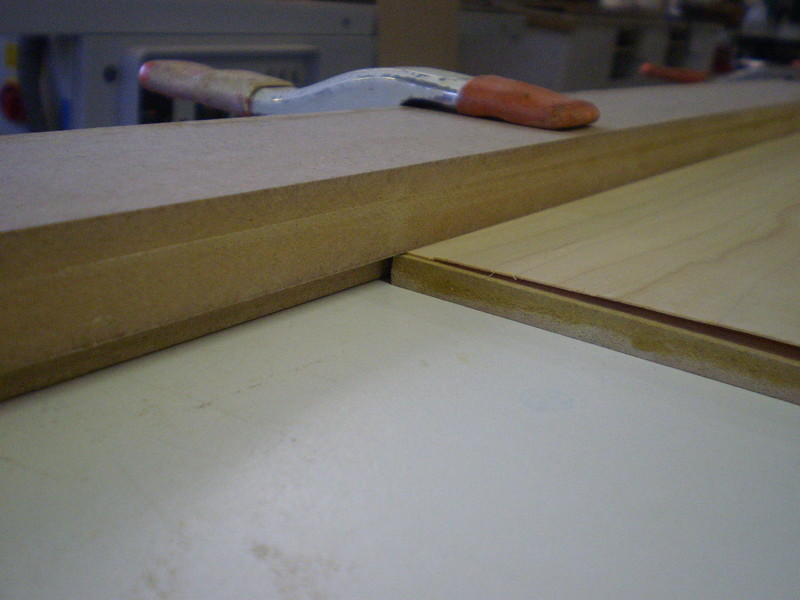
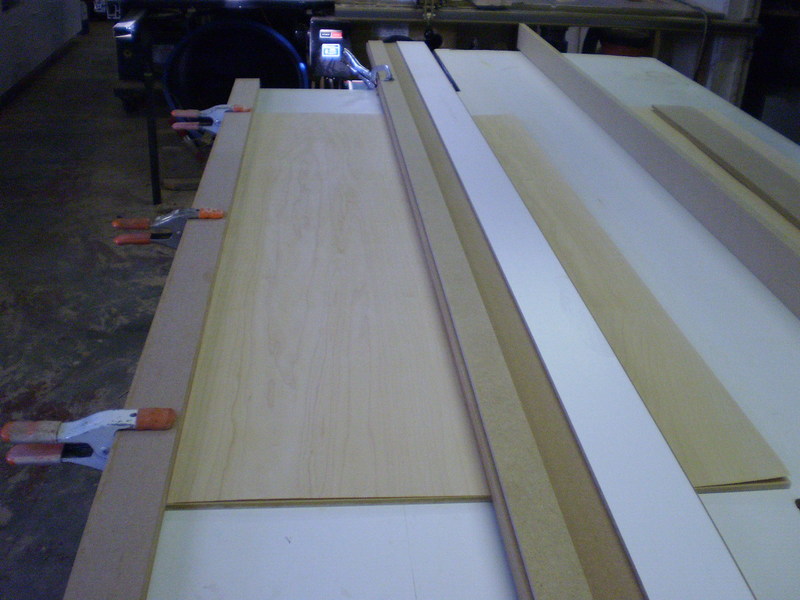
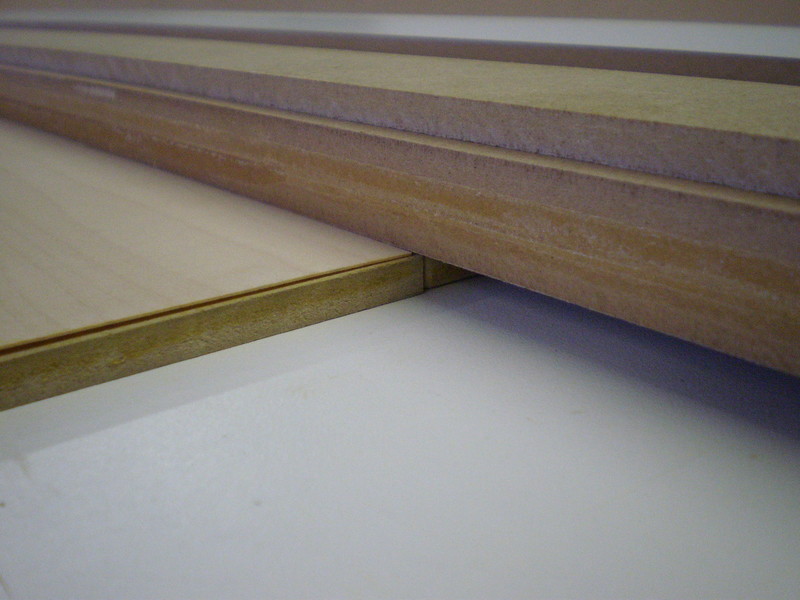
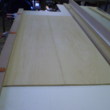 As pictured, the left hand sheet is sitting on the bottom cover sheet, the right on top of the top cover sheet. There are a few pieces of tape under the loose veneer joint that will help to keep the two pieces aligned when the right is folded over the left.
Most of my glue spreader guides/fences have a 1/4" notch on one side. Here the notch in the left hand guide is used to clamp the veneer to the cover sheet/workbench. When ready to spread the glue, the right guide is clamped in a similar matter. Once the glue is spread, the right hand guide is removed and the right hand sheet of veneer is folded over the left.
Glue is always spread on the substrate, never the veneer. One reason is that veneer starts bowing and rippling as soon as glue is applied to it. While the above worked well, getting the sandwich all lined up and into the press became a bit of a challenge after removing the guides. Taping the veneer to the cover sheets might have helped.
[ comment | link | top ]
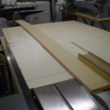 I get the best seams when I rip stacks of veneer sandwiched between two sheets of 1/4" MDF. I keep the sandwich together/aligned with glue applied to the ends of the stack. So long as the stack is not flexed a lot, the glue holds surprisingly well. Hotmelt also works, but glue allows separating individual pieces from the cut stack using a utility blade.
To cut the stack, I use a triple chip (TCG) blade. Zero/negative hook blades, e.g. for melamine cutting, seem to work best. I walk (hand over hand) the stack through the saw with my hands near the blade. Even with the relatively flat stack example, it's important to keep the stack as flat/tight as possible where its going through the blade. Walking the stack through allows constant downward pressure and a slow/steady feed rate (I'm real curious if a power feeder would work). I've used weights to help when crosscutting.
For odd shaped pieces (and seams), I tape the pieces/stacks to the MDF.
[ comment | link | top ]
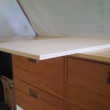
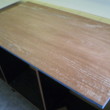
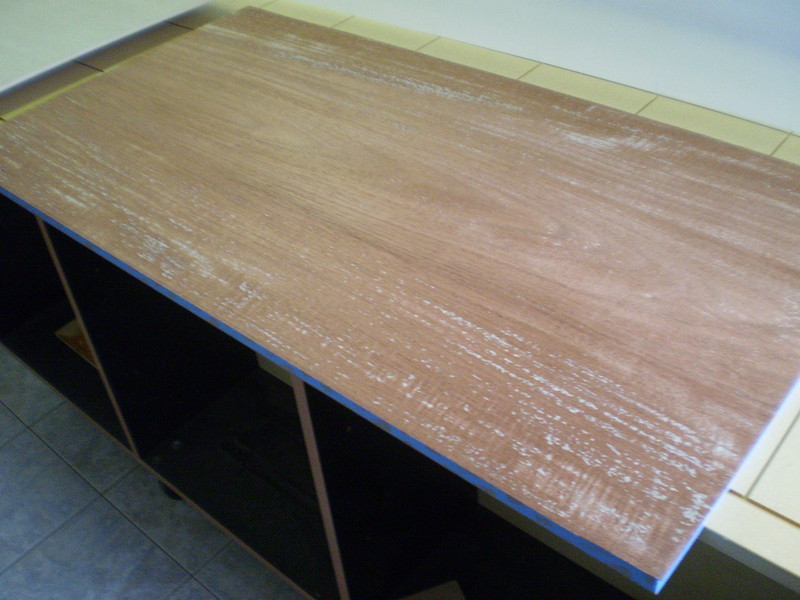
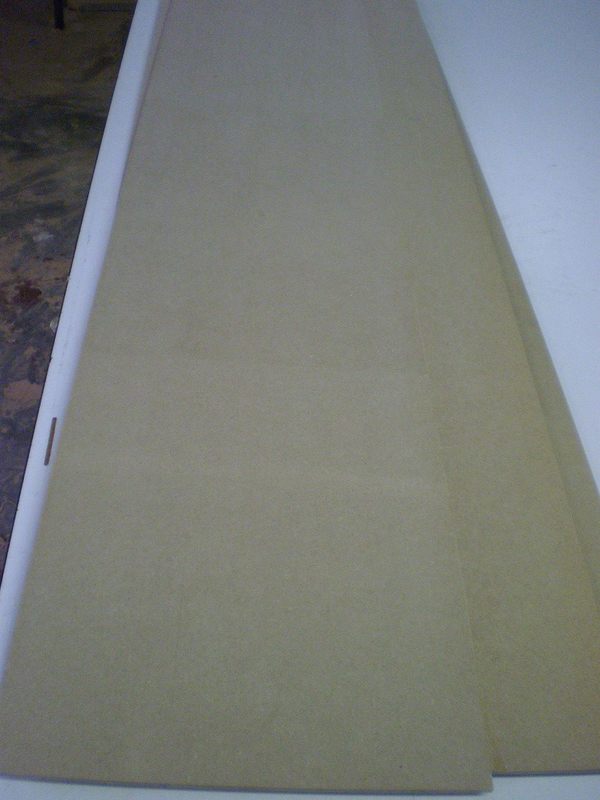
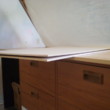 Since there are only a few months out of the year when my shop is even close 70 degrees (required for plastic resin veneering), I only veneer with water based glues. My preferred method of veneering with water based glues is to use MDF cover sheets. Water based glues set when the surrounding materials absorb the glues moisture content. While the substrate will eventually absorb enough moisture for the glue to set, using an MDF cover sheet speeds the process up. An MDF cover sheet will come out of the press bowed on the veneer side (1st image). This is because the cover sheet is close to the glue line and it's easier/faster for the moisture in the glue to pass through the veneer and into the cover sheet than it is to go deeper into the substrate. Both the layup and the cover sheet will flatten as the moisture content returns to normal (2nd image). With 1/4" cover sheets, the press time can be the same as the recommended clamp time, e.g. 30 minutes for most? PVA's. I have been known to leave things in the press for as long as an hour, e.g. veneer I really should have softened before gluing, but longer is overkill.
 If things aren't setting well after 30 minutes, the glue line is probably too thick. Getting a lot of bleed through on porous veneers (typically quarter grain) is a good indicator. The image is my worse case of bleed through (in retrospect, the quarter grain is obvious and I should have taken more care w/ the glue). While it wasn't enough to noticeably slow down glue set, it was enough to test MDF peel strength. While seemingly seriously stuck to the veneer, once started, it was relatively easy to peel the MDF cover sheet off the veneer (closeups of veneer and MDF). When I take care with glue coverage, I seldom have bleed through. Glue pips on the MDF is typical on quarter sawn, but no, or very minimal (typically a crack or other flaw), spreading on the face of veneer... Something I did recently on cracked burl was add a layer of unprinted newspaper between the veneer and MDF. It wasn't much of a test because there almost no bleed through and the few bits of stuck paper were easy to clean off, i.e. I don't know how well it would work if there were a lot of bleed through.
Another advantage of an MDF cover sheet is that it is porous in all directions. I discovered this when I made a 1/4" MDF box using internal vacuum to clamp it (no bag/press). Paper held to the outside of the box would kind of stick to it because air was passing though the face of the MDF. The 1/4" MDF works a bit like breather mesh, it can conform to subtle irregularities and helps to prevent trapped higher pressure air pockets and insure even vacuum pressure on the veneer. While 1/8" MDF might conform to slightly irregular surfaces better, I have not had a reason to try it.
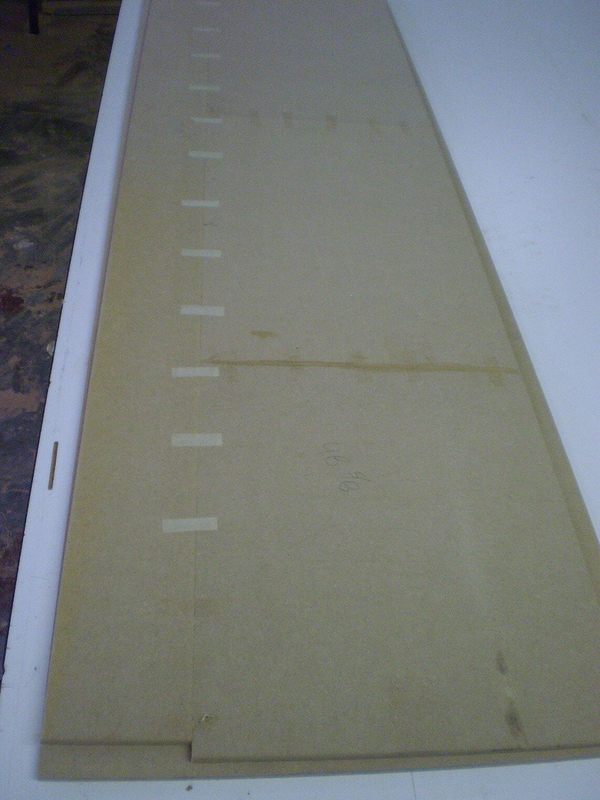
Using MDF cover sheets for pressing and cutting seams can result in a lot of scrap. Gluing those scraps together, holding them together with a bit of tape on top (4pcs, 3 joints) and putting them in the press, is one way to put them to use. The resulting seams are flush on the bottom and surprisingly strong.
[ comment | link | top ]
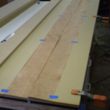 I use a custom notched spreader to apply glue for all veneer press layups. Trying to do it freehand is doable, but guides make it a lot easier. The guides keep the glue from going over the edges and hold the panel in place. The guides should be 1/8" or more thicker than the panel being glued. Having the far guide be at least as wide as the veneer allows for taping the veneer to the guide(s, image) and folding it back onto the guide - lined up and ready to set in the glue. The far guide is the same length as the workbench so that it is easy to clamp in place. The close guide only needs to be as long as the panel being glued. I use spring clamps clamped so that they push the close guide tight to the panel.
Since the easiest place not to get enough glue is along the edges I pour a heavy bead near the edges and run the spreader along the edges first. I angle the spreader as needed to keep enough glue along the edge - not so much that it climbs over the guide. The goal when spreading is to get an even spread with no high beads from glue running around the side of the spreader. I figure its OK to be picky and take a bit of time to allow a bit of glue/moisture to soak into the MDF. Ultimate glue line thickness will depend on the angle of the spreader, how much glue you push with it (little to none equals thinner glue line), and how clean of glue the flats between the glue lines are. It is a good idea to test each veneer you will be using as some will need more glue than others.
YouTube video: Gluing Wood Veneer w/ notched spreader
See also: Tools : Glue Spreader
[ comment | link | top ]
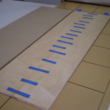 While veneer tape is the best way to get a good tight seam, it takes a lot of time - tape the seam tight on the back side, apply veneer tape to the front side, remove the tape from the back side, press and then remove the veneer tape.
It is possible to get a good seam by just taping the face of the veneer using 3M's Delicate Surfaces tape. The tapes low adhesion means that it needs to be pressure rolled when pulling the seam tight or the tape won't stay stuck to the veneer. The advantage is that the press won't stick it any more and you'll be able to remove it without any grain tearing.
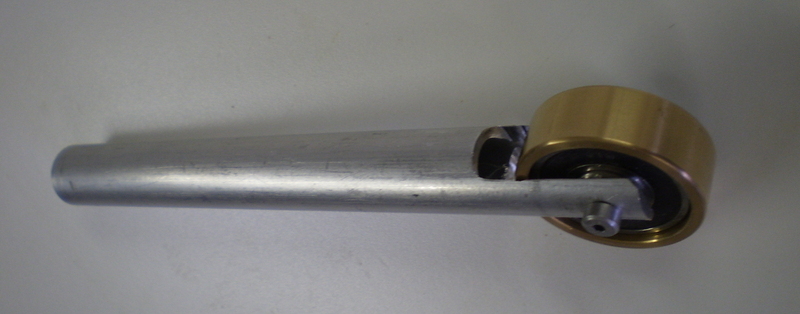
I use 1/2" tape and a 9/16" wide custom roller. A 3/4-1" wide roller would probably be best, mine is prone to tipping. Joe's 2" seaming roller might be too wide to provide the needed pressure. Running a lengthwise strip isn't necessary if you run enough cross pieces (a cut to length tape dispenser is handy for this).
[ comment | link | top ]
Veneering
PVA Glue
I really like veneering with PVA because it's fast, easy and reliable at lower temperatures. The most important aspect is not too use too much glue. While filled and slow set PVA's are an option, I prefer plain old Titebond. While I use Titebond II, some prefer the harder setting original Titebond (I've never tried it).
What finally motivated this post was two lines from a recent email I received from Edward Ferri at qualityvak.com:
"Typical Yellow & White Glues : 68°f recommended temperature.
VAK-Bond 2000 : 65°f minimum recommended temperature. "
Plastic resin glues require a chemical reaction to cure properly. That reaction typically requires a minimum temperature of 70-75 F. If VAK-Bond 2000 can produce a reliable bond at 65 F, that's great.
My issue is with the statement that 68 F is recommended when using PVA's (a source request went unanswered). PVA glues set when they dry out, when the surrounding materials (little to zero environmental influence) absorb moisture from glue. Temperature only has an effect when it is too low for the remaining adhesive particles to bond properly. That temperature is typically 50-55 F and is known as chalk temperature (white/chalky looking glue line).... more
[ page | top ]
What finally motivated this post was two lines from a recent email I received from Edward Ferri at qualityvak.com:
"Typical Yellow & White Glues : 68°f recommended temperature.
VAK-Bond 2000 : 65°f minimum recommended temperature. "
Plastic resin glues require a chemical reaction to cure properly. That reaction typically requires a minimum temperature of 70-75 F. If VAK-Bond 2000 can produce a reliable bond at 65 F, that's great.
My issue is with the statement that 68 F is recommended when using PVA's (a source request went unanswered). PVA glues set when they dry out, when the surrounding materials (little to zero environmental influence) absorb moisture from glue. Temperature only has an effect when it is too low for the remaining adhesive particles to bond properly. That temperature is typically 50-55 F and is known as chalk temperature (white/chalky looking glue line).... more
[ page | top ]
Two Ply Veneer
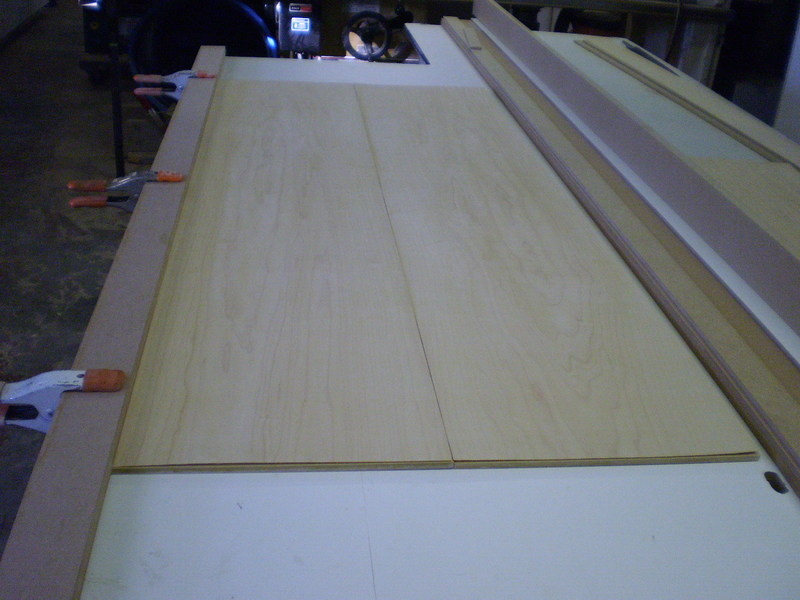 As pictured, the left hand sheet is sitting on the bottom cover sheet, the right on top of the top cover sheet. There are a few pieces of tape under the loose veneer joint that will help to keep the two pieces aligned when the right is folded over the left.
 Most of my glue spreader guides/fences have a 1/4" notch on one side. Here the notch in the left hand guide is used to clamp the veneer to the cover sheet/workbench. When ready to spread the glue, the right guide is clamped in a similar matter. Once the glue is spread, the right hand guide is removed and the right hand sheet of veneer is folded over the left.
Glue is always spread on the substrate, never the veneer. One reason is that veneer starts bowing and rippling as soon as glue is applied to it. While the above worked well, getting the sandwich all lined up and into the press became a bit of a challenge after removing the guides. Taping the veneer to the cover sheets might have helped.
[ comment | link | top ]
Seam Cutting
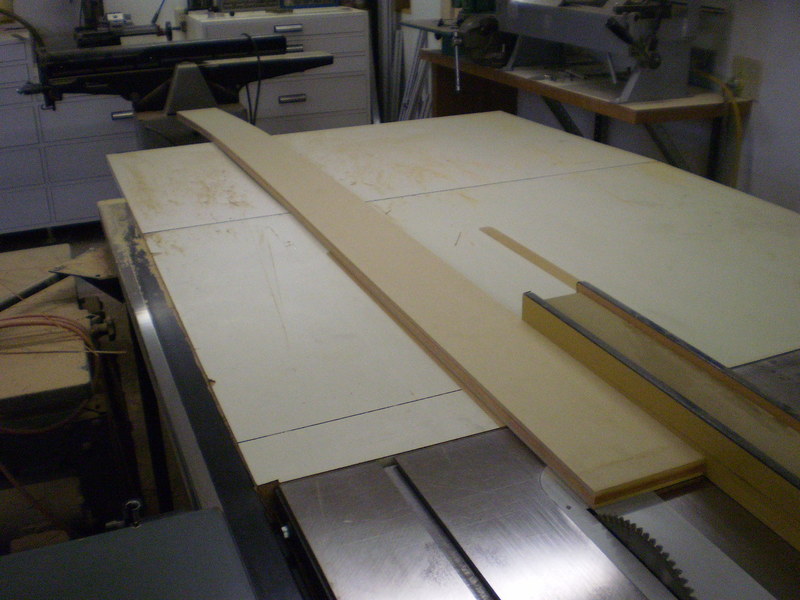 I get the best seams when I rip stacks of veneer sandwiched between two sheets of 1/4" MDF. I keep the sandwich together/aligned with glue applied to the ends of the stack. So long as the stack is not flexed a lot, the glue holds surprisingly well. Hotmelt also works, but glue allows separating individual pieces from the cut stack using a utility blade.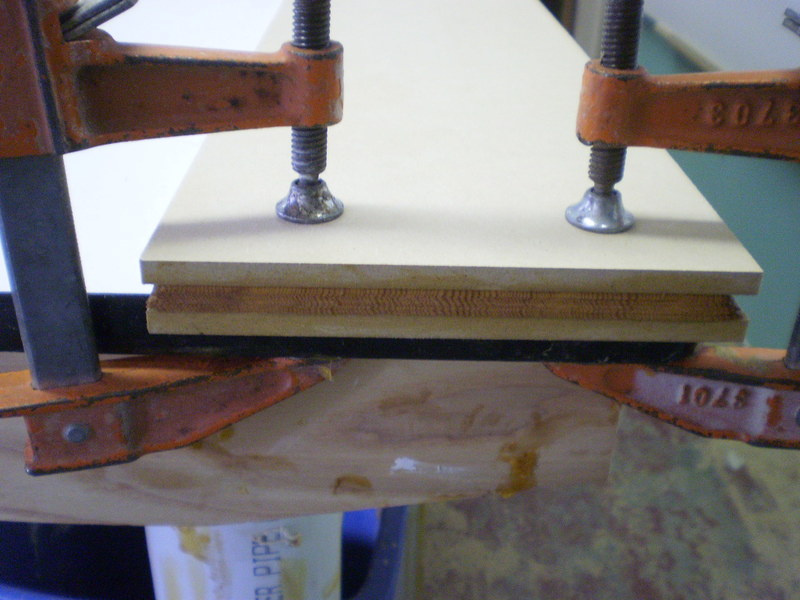

To cut the stack, I use a triple chip (TCG) blade. Zero/negative hook blades, e.g. for melamine cutting, seem to work best. I walk (hand over hand) the stack through the saw with my hands near the blade. Even with the relatively flat stack example, it's important to keep the stack as flat/tight as possible where its going through the blade. Walking the stack through allows constant downward pressure and a slow/steady feed rate (I'm real curious if a power feeder would work). I've used weights to help when crosscutting.
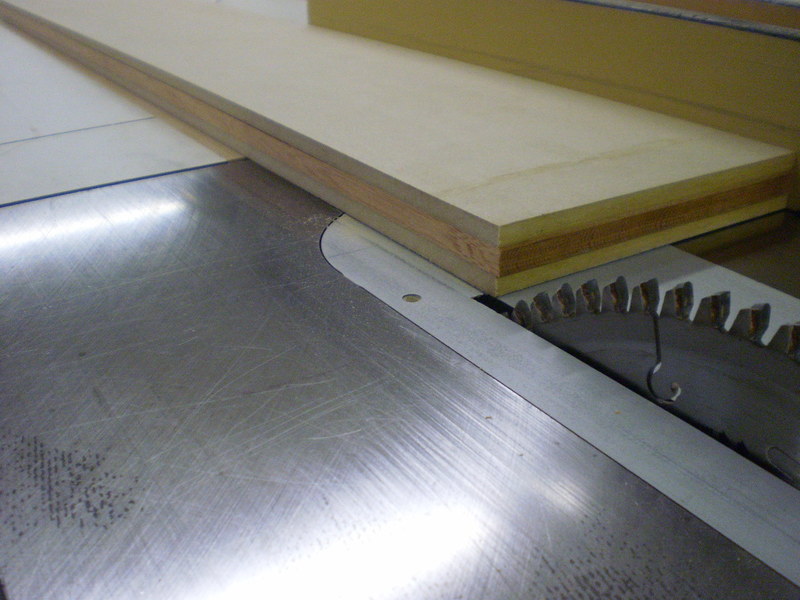

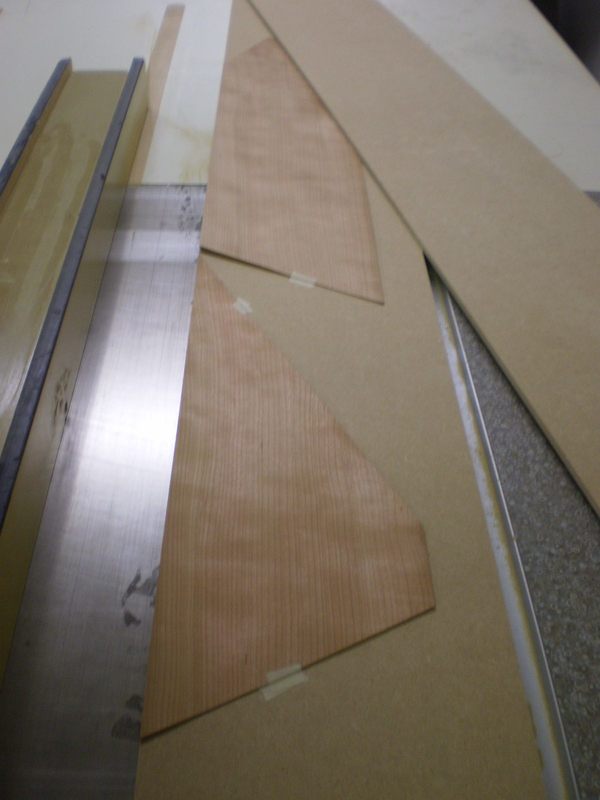
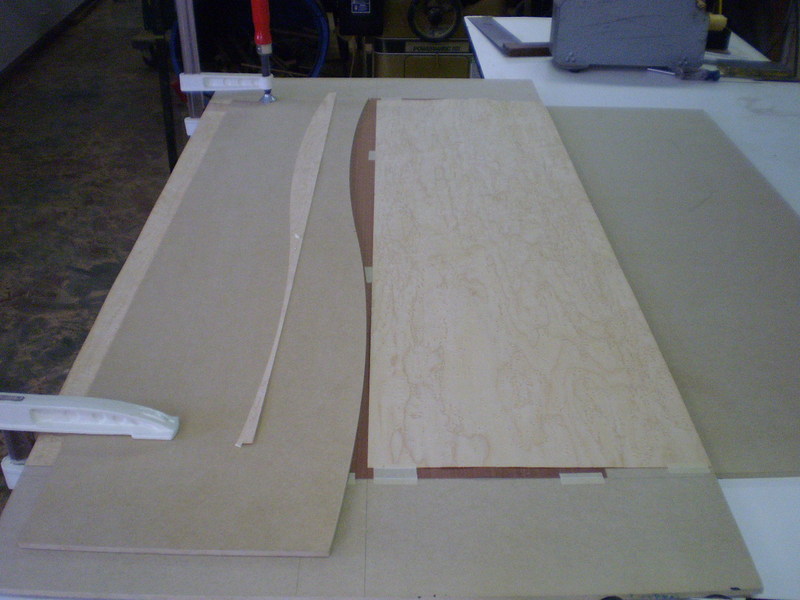
For odd shaped pieces (and seams), I tape the pieces/stacks to the MDF.
[ comment | link | top ]
MDF Cover Sheets
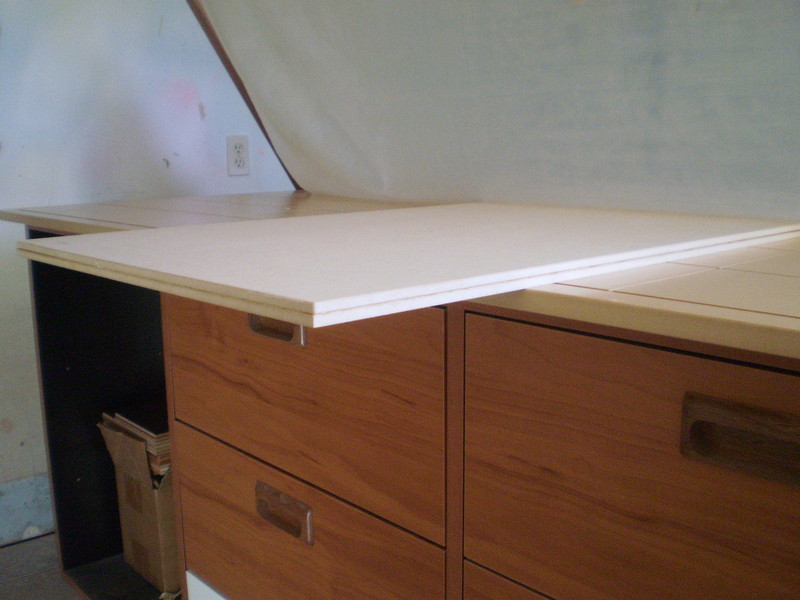
 Since there are only a few months out of the year when my shop is even close 70 degrees (required for plastic resin veneering), I only veneer with water based glues. My preferred method of veneering with water based glues is to use MDF cover sheets. Water based glues set when the surrounding materials absorb the glues moisture content. While the substrate will eventually absorb enough moisture for the glue to set, using an MDF cover sheet speeds the process up. An MDF cover sheet will come out of the press bowed on the veneer side (1st image). This is because the cover sheet is close to the glue line and it's easier/faster for the moisture in the glue to pass through the veneer and into the cover sheet than it is to go deeper into the substrate. Both the layup and the cover sheet will flatten as the moisture content returns to normal (2nd image). With 1/4" cover sheets, the press time can be the same as the recommended clamp time, e.g. 30 minutes for most? PVA's. I have been known to leave things in the press for as long as an hour, e.g. veneer I really should have softened before gluing, but longer is overkill.
 If things aren't setting well after 30 minutes, the glue line is probably too thick. Getting a lot of bleed through on porous veneers (typically quarter grain) is a good indicator. The image is my worse case of bleed through (in retrospect, the quarter grain is obvious and I should have taken more care w/ the glue). While it wasn't enough to noticeably slow down glue set, it was enough to test MDF peel strength. While seemingly seriously stuck to the veneer, once started, it was relatively easy to peel the MDF cover sheet off the veneer (closeups of veneer and MDF). When I take care with glue coverage, I seldom have bleed through. Glue pips on the MDF is typical on quarter sawn, but no, or very minimal (typically a crack or other flaw), spreading on the face of veneer... Something I did recently on cracked burl was add a layer of unprinted newspaper between the veneer and MDF. It wasn't much of a test because there almost no bleed through and the few bits of stuck paper were easy to clean off, i.e. I don't know how well it would work if there were a lot of bleed through.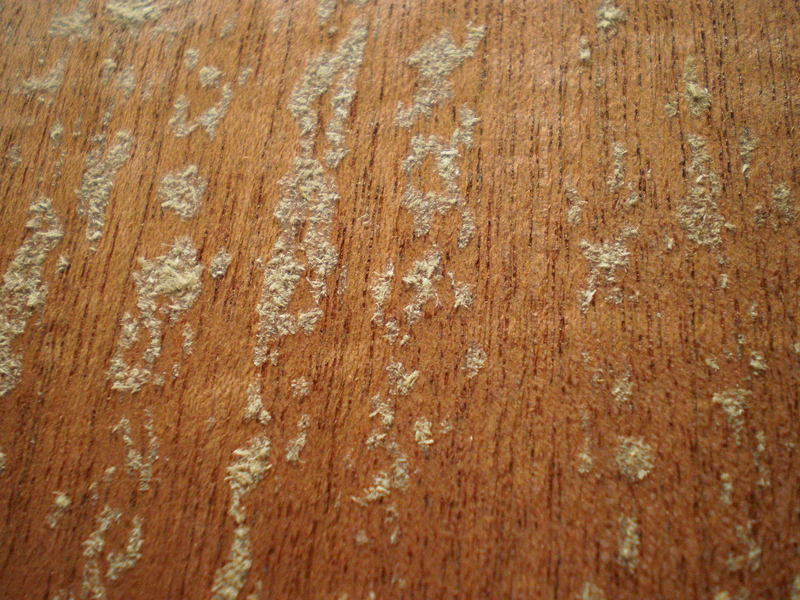

Another advantage of an MDF cover sheet is that it is porous in all directions. I discovered this when I made a 1/4" MDF box using internal vacuum to clamp it (no bag/press). Paper held to the outside of the box would kind of stick to it because air was passing though the face of the MDF. The 1/4" MDF works a bit like breather mesh, it can conform to subtle irregularities and helps to prevent trapped higher pressure air pockets and insure even vacuum pressure on the veneer. While 1/8" MDF might conform to slightly irregular surfaces better, I have not had a reason to try it.
Using MDF cover sheets for pressing and cutting seams can result in a lot of scrap. Gluing those scraps together, holding them together with a bit of tape on top (4pcs, 3 joints) and putting them in the press, is one way to put them to use. The resulting seams are flush on the bottom and surprisingly strong.
[ comment | link | top ]
Wet and Peel Tape Removal
The best way I have found to remove veneer joint tape is the wet-and-peel method. I use a sponge top bottle to wet the tape and a finger to spread and keep the tape evenly moistened. Since its important that the edges of the tape are as wet as the rest of the tape, getting a bit of water on the veneer is inevitable. It will take a couple of minutes for the moisture to soak through to the glue. Use a minimal amount of water and take the tape off as soon as you can.
Getting the peel started can be a bit tricky. While not always convenient, leaving the tape long can make it easier - so long as glue squeeze doesn't get stuck to it. A utility knife blade will help get the peel started as well as keeping it going when the tape wants to tear. I also use a utility blade to scrape off any bits of residue left behind - typically near where the edge of the tape was.
As with tape removal, the application of veneer tape should introduce the least amount of moisture possible. The veneer tape adhesive needs to be thoroughly and evenly whetted without excess water. I prefer to run tensioned tape over a sponge at a speed that insures that the adhesive is evenly tacky, just enough to get a good consistent bond.
YouTube video: Removing Wood Veneer Tape
See also: Joe Woodworker Veneer Taping and FAQ #11
[ comment | link | top ]
Getting the peel started can be a bit tricky. While not always convenient, leaving the tape long can make it easier - so long as glue squeeze doesn't get stuck to it. A utility knife blade will help get the peel started as well as keeping it going when the tape wants to tear. I also use a utility blade to scrape off any bits of residue left behind - typically near where the edge of the tape was.
As with tape removal, the application of veneer tape should introduce the least amount of moisture possible. The veneer tape adhesive needs to be thoroughly and evenly whetted without excess water. I prefer to run tensioned tape over a sponge at a speed that insures that the adhesive is evenly tacky, just enough to get a good consistent bond.
YouTube video: Removing Wood Veneer Tape
See also: Joe Woodworker Veneer Taping and FAQ #11
[ comment | link | top ]
Gluing with a Notched Spreader
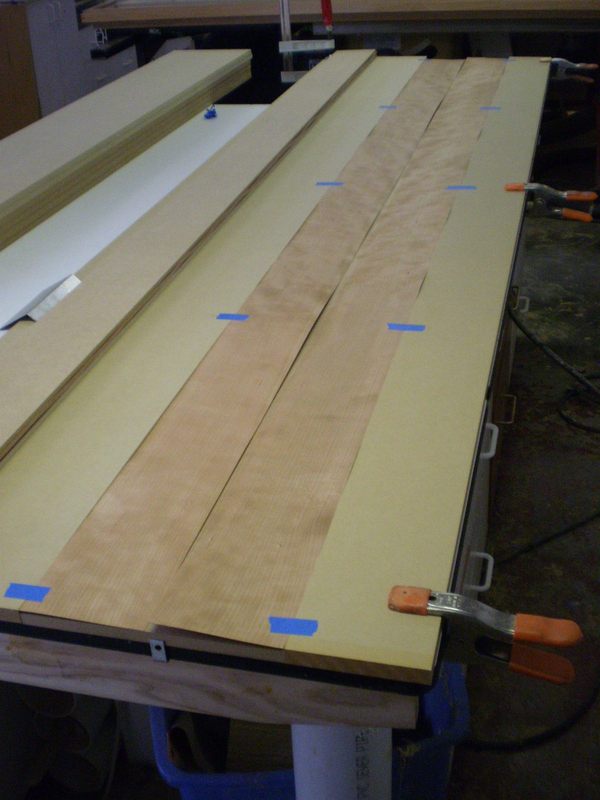 I use a custom notched spreader to apply glue for all veneer press layups. Trying to do it freehand is doable, but guides make it a lot easier. The guides keep the glue from going over the edges and hold the panel in place. The guides should be 1/8" or more thicker than the panel being glued. Having the far guide be at least as wide as the veneer allows for taping the veneer to the guide(s, image) and folding it back onto the guide - lined up and ready to set in the glue. The far guide is the same length as the workbench so that it is easy to clamp in place. The close guide only needs to be as long as the panel being glued. I use spring clamps clamped so that they push the close guide tight to the panel.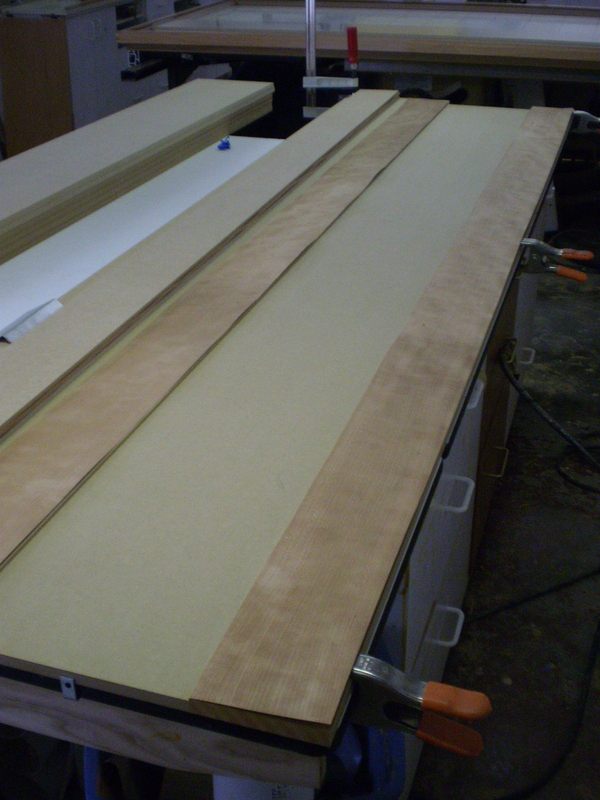
Since the easiest place not to get enough glue is along the edges I pour a heavy bead near the edges and run the spreader along the edges first. I angle the spreader as needed to keep enough glue along the edge - not so much that it climbs over the guide. The goal when spreading is to get an even spread with no high beads from glue running around the side of the spreader. I figure its OK to be picky and take a bit of time to allow a bit of glue/moisture to soak into the MDF. Ultimate glue line thickness will depend on the angle of the spreader, how much glue you push with it (little to none equals thinner glue line), and how clean of glue the flats between the glue lines are. It is a good idea to test each veneer you will be using as some will need more glue than others.
YouTube video: Gluing Wood Veneer w/ notched spreader
See also: Tools : Glue Spreader
[ comment | link | top ]
Blue Tape Seaming
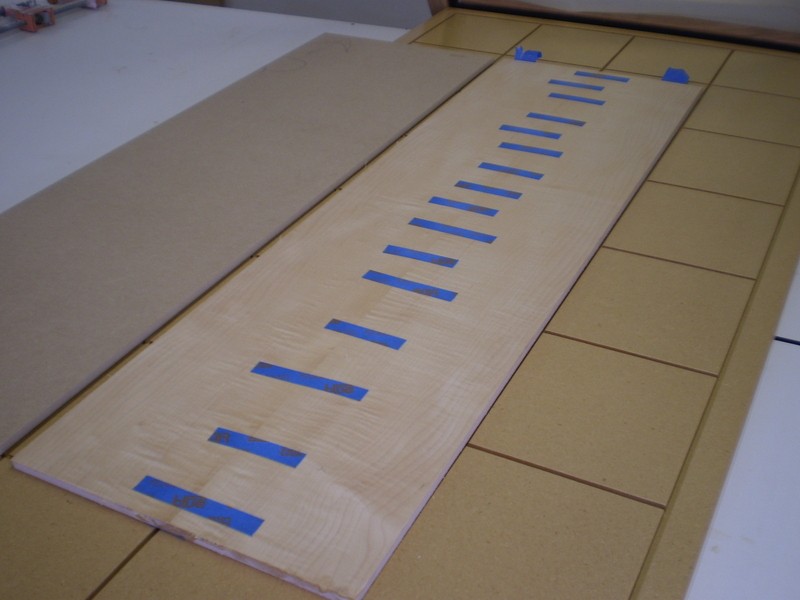 While veneer tape is the best way to get a good tight seam, it takes a lot of time - tape the seam tight on the back side, apply veneer tape to the front side, remove the tape from the back side, press and then remove the veneer tape.
 It is possible to get a good seam by just taping the face of the veneer using 3M's Delicate Surfaces tape. The tapes low adhesion means that it needs to be pressure rolled when pulling the seam tight or the tape won't stay stuck to the veneer. The advantage is that the press won't stick it any more and you'll be able to remove it without any grain tearing.
I use 1/2" tape and a 9/16" wide custom roller. A 3/4-1" wide roller would probably be best, mine is prone to tipping. Joe's 2" seaming roller might be too wide to provide the needed pressure. Running a lengthwise strip isn't necessary if you run enough cross pieces (a cut to length tape dispenser is handy for this).
[ comment | link | top ]
Tapes
Common tapes used in veneering are masking tape and veneer tape. For temporary holding/locating pieces 3M's Multi-Surfaces #2090 blue painters tape is typically the tape of choice. 3M's General Purpose #2020 tape has a bit stronger adhesion and I have yet to have a problem (e.g. grain tear) with it. Neither tape is good for use on veneer in a vacuum press because they will become hard to remove and may cause grain tear.
The best masking tape for use on veneer that will be put in a vacuum press is 3M's Delicate Surfaces #2080 blue tape. This tape has low adhesion, but can leave a bit of residue. Any residue can be removed with tape or a sanding belt/disk cleaning stick (haven't tried erasers or drawing cleaner pads). This tape can be used for seaming if pressure rolled to create an adequate bond.
Another PSA tape used for seaming is Joe's Quick Stitch tape. While some folks like this, I am not a fan. This tape has very strong adhesion and is quite thick. Even with a heat gun to soften the adhesive, I got grain tear trying to remove this from VG Fir veneer. This tape (.004") is twice as thick as veneer tape and 3M's 2080 (both .002"). I use 1/4" raw MDF cauls and this tape leaves a noticeable depression in the veneer (even .002 tape leaves a slight depression). This tape doesn't help to create a tight seam either, veneer tape shrinks when it dries and 2080 has a bit a of stretch - both can pull/hold seams tight.
My preference is 3/4" no-hole veneer tape. While some folks prefer holes so that they can see the seam (a good seam is hard to see and this didn't work well for me), no-hole tape is the only way I would try the wet-and-peel method of veneer tape removal. I put bits of 3/4" blue tape centered off the ends of the seam for locating the veneer tape. On long seams I place a couple of short pieces in the center ~1/2" from the seam and center the veneer tape in the gap.
[ comment | link | top ]
The best masking tape for use on veneer that will be put in a vacuum press is 3M's Delicate Surfaces #2080 blue tape. This tape has low adhesion, but can leave a bit of residue. Any residue can be removed with tape or a sanding belt/disk cleaning stick (haven't tried erasers or drawing cleaner pads). This tape can be used for seaming if pressure rolled to create an adequate bond.
Another PSA tape used for seaming is Joe's Quick Stitch tape. While some folks like this, I am not a fan. This tape has very strong adhesion and is quite thick. Even with a heat gun to soften the adhesive, I got grain tear trying to remove this from VG Fir veneer. This tape (.004") is twice as thick as veneer tape and 3M's 2080 (both .002"). I use 1/4" raw MDF cauls and this tape leaves a noticeable depression in the veneer (even .002 tape leaves a slight depression). This tape doesn't help to create a tight seam either, veneer tape shrinks when it dries and 2080 has a bit a of stretch - both can pull/hold seams tight.
My preference is 3/4" no-hole veneer tape. While some folks prefer holes so that they can see the seam (a good seam is hard to see and this didn't work well for me), no-hole tape is the only way I would try the wet-and-peel method of veneer tape removal. I put bits of 3/4" blue tape centered off the ends of the seam for locating the veneer tape. On long seams I place a couple of short pieces in the center ~1/2" from the seam and center the veneer tape in the gap.
| 40 gram veneer tape | .002" |
| 3M #2080 | .002" |
| 3M crepe tapes (#2090, #2020) | .003" |
| Quick Stitch | .004" |
[ comment | link | top ]