
Home : 32mm : Drawers :
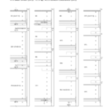 Like the faces, all drawer boxes are some increment of 32mm tall. Doing this provides a consistent relationship between the drawer boxes and faces. While the boxes cannot center on the faces, they will all be the same distance from the top and bottom of all faces. All drawer/face combos can be located anywhere in the stack.
While wood drawer box height can be plus or minus a constant (e.g. to provide top clearance), the bottom clearance is fixed. With under and bottom mount slides, the bottom drawer slide mounting hole determines how far the bottom of all drawer boxes will be from the bottom of all faces.
All system registered cabinets (0 bottom reveal) have a system hole 62.5 from the bottom of the cabinet. Subtract the cabinet bottom thickness to get available bottom clearance (BC). In the example, 62.5 - 19 = 43.5. Both Blum (example, 37 BC) and Salice (42.5 BC) under-mounts will work. Bottom-mounts (~19), Metabox (~19) and Zargon (~16) waste too much space.
[ link | top ]
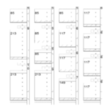 I first heard of "Shifted" system rows from Keith Hill and Bob Buckley (True32) in the late '90s. Blum has since ('04?) switched from "System" to "Shifted" for their Process 32. The system rows on any given panel design can be shifted vertically by 16mm. When the system rows are shifted, all door and drawer top and bottom edges (plus 1/2 reveal) center between system holes. Shifting the system rows can provide additional bottom drawer clearance without breaking the 32mm system.
All cabinets using shifted system holes, and having no bottom reveal, have a system hole 46.5 from the bottom of the cabinet (assuming 3mm gaps, 48 - 1/2 gap = 46.5). With 19mm stock, BC is 27.5 (46.5 - 19). While not great, Bottom-mounts, Metabox and Zargon (example) work much better here (VS sys reg). Under-mounts with a second row of mounting holes, e.g. 37/25 BC, also work a bit better here. While the bottom slide can only be mounted using the lower row, and while it seems silly to not mount the rest of the drawers using the top row, it's the only way to maintain consist relationship between all drawer boxes and faces. Salice undermounts (42.5/30.5BC) won't work here, neither will Tandembox (single row 33BC)... Going up a hole (59.5 BC), Grass Nova Pro (49.5 BC) works OK, Hafele Classic (56 BC) works much better.
[ link | top ]
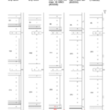 The KISS II system, with its 4.5mm bottom (and top) reveal, allows for better drawer layouts when using Grass Zargon or Grass/Hettich bottom-mount slides. I know of no other brands or styles of slides that benefit from the KISS II 4.5mm bottom reveal. Increased reveals can be used with Shifted and System panel designs. The drawback is that bottom reveals can look bad, especially on uppers where the box banding is not an exact match to the door faces.
With no bottom reveal, the distance from the drawer slide mounting hole to the top of the cabinet bottom (BC) is typically 43.5 system/27.5 shifted (3mm gaps, 19mm deck). Increasing bottom reveal by 4.5 lowers the cabinet bottom by 4.5 which increases BC by 4.5. KISS (system reg) has a BC of 48 (43.5 + 4.5) or 16 (48 - 32).
...The Grass Nova Pro requires a 49.5 BC and the KISS II manual suggests they are usable and to use the side adjustment screws (+/-2mm) to drop the bottom face 1.5mm (49.5 - 48 BC = 1.5). With shifted 0 bottom reveal cabinets the Nova slides would be 10mm off the deck.
When using undermounts, bottom reveals greater than 0 and less than 9.5mm only add space under the bottom system registered drawer. With shifted registration, the bottom reveal would need to be increased to 9.5 to move standard undermounts (37 BC, 27.5 + 9.5 reveal) down one system hole (e.g. HO's 11mm reveal).
[ link | top ]
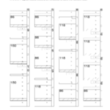 Making the bottom drawer box 32mm smaller and moving the bottom slide up a notch is another possibility. Doing this increases the bottommost drawer box to face reveal by 32mm. The gained usable space in the rest of the drawers can more than make up for the 32mm loss in the bottom drawer. A plus-32 bottom face can be center or top indexed (which excludes the bottom indexed Zargon slides). With full overlay bottom faces, top indexing is the best option. A plus-32 face can be used with Shifted and System panel designs. The example is one of the best layouts I've been able to come up with for Metabox slides (71mm top index).
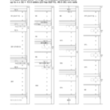 Plus 32 is great if the drawer face above the bottom face is one increment smaller because the bottom two drawer boxes (or Metabox side/slide) are the same size. Another plus, when using shifted registration, is that the drawer boxes can be (32 x n) + 5 (- 3 in the example, up to + 13.5 works) which makes the top of all drawer boxes 32mm below the tops of the drawer faces. Holes for mounting the faces (via screws, adjusters, dowels, whatever) can be some multiple or increment (+/- a constant) of 32mm from the top of all faces and boxes.
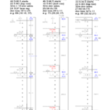 ...This drawing compares Plus 32 with straight 32mm system undermount drawer layouts. While the Plus 32 layout doesn't gain a significant amount of space (+4/16mm) on a three drawer layout, it moves all lost space to the bottom of the cabinet. For every additional drawer, Plus 32 gains 13/16mm (shifted/system reg) more usable space. The shifted registration example (middle) uses the lower row of mounting holes (not all slides have them).
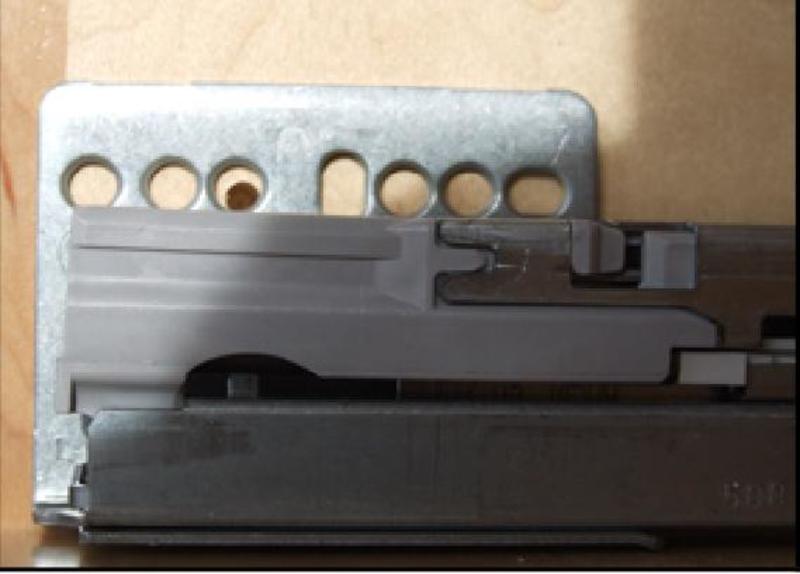
Example image is a plus-32 drawer bank with shifted top registration (no rails).
[ link | top ]
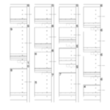 Center indexing is when the center of the drawer box and face center on, or between, the same system holes. True center indexing (same top/bottom face reveal) is only possible with half-overlay and flush-inset cabinets. With full-overlay cabinets, bottom (and top) clearances become an issue. With center indexed drawers, the top and bottom box-to-face reveals need to be the same. Using a plus 32 face, the bottom box needs to be 64mm smaller to increase both the top and bottom face-to-box reveals by 32mm, i.e. is a pretty lousy option.
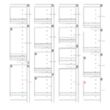 When using boxes sized for center indexing, adding 32mm to the bottom of a face has no affect on the top box-to-face reveals. All hardware can be mounted some increment of 32mm plus (box) or minus (face) top reveal. With drawer layouts where the face above the plus-32-face is 32mm smaller, the two boxes will be the same size, i.e. top indexing can reduce the the number of box sizes. Holes for drawer front adjusters can be the same for both drawers. The only drawback is that you cannot bore for centered pulls at the same time. That may not matter, e.g. if all pulls get bored an equal distance from the top of the faces. While I've improved the layout (its the same as Plus 32 above), the bottom drawers are not center indexed, i.e. is not a valid center indexing option.
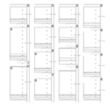 The only reasonable method I've been able to come up with (for full-overlay) requires drilling extra holes for mounting the bottom slide. When the slides of the above top-indexed bottom box are moved down 16mm (mounting holes centered between system holes), the box is once again centered on the face. While centered, the box-to-face reveals for the shifted drawer are 16mm bigger than the rest. This isn't an issue because increments of 32mm can be odd or even and the center of odd increment faces are always some increment of 16mm (never 32mm) bigger/smaller than even increment faces. In other words, doing this breaks nothing. All faces will center on all boxes. The only difference is that the bottom box gets a 32mm bigger face. This option (and Plus 32) only bugs me when the bottom two drawer faces are the same size and the bottom box is 32mm smaller (far right in the example drawing).
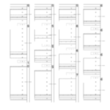 ...Above I had said that true center indexing is only possible with half-overlay and inset cabinets. Apparently I had rejected this system registration drawing (the three examples above use shifted registration) because it wasted too much space. None the less, it is an example of true center indexing.
Note: While the drawings are labled Eclipse, the Eclipse box offset specs are the same/very close to most undermount specs (22.5 BO). If you want any of these drawings updated, e.g. with dimensions/specs, let me know.
See also: Full Overlay Undermount. The 3rd example in both drawings is center indexed.
[ link | top ]
Full Overlay Bottom Clearance
With half-overlay and inset cabinets, all horizontal carcase components (top, bottom and stretchers/rails) center on, or between, system holes and all drawer openings are the same size (when drawer rails are used). Bottom clearance (BC), the distance from the drawer slide mounting holes to any horizontal component, is the same for all openings.
The only way to get a full overlay on the bottom of the cabinet is to move the bottom of the cabinet up (any other option breaks the system, e,g, unbalanced hinge cup boring). Moving the cabinet bottom up reduces the size of the bottom drawer opening and the distance from the drawer slide mounting hole to the bottom of the cabinet. Because the drawer slides are mounted some multiple of 32mm apart, the reduced bottom drawer clearance results in wasted space under the rest of the drawers. The following covers ways to minimize wasted space, but the bottom line is that you either use the 32mm system and waste some space, or trade some of the consistency that the system provides for more usable space.
The only way to get a full overlay on the bottom of the cabinet is to move the bottom of the cabinet up (any other option breaks the system, e,g, unbalanced hinge cup boring). Moving the cabinet bottom up reduces the size of the bottom drawer opening and the distance from the drawer slide mounting hole to the bottom of the cabinet. Because the drawer slides are mounted some multiple of 32mm apart, the reduced bottom drawer clearance results in wasted space under the rest of the drawers. The following covers ways to minimize wasted space, but the bottom line is that you either use the 32mm system and waste some space, or trade some of the consistency that the system provides for more usable space.
System Registration
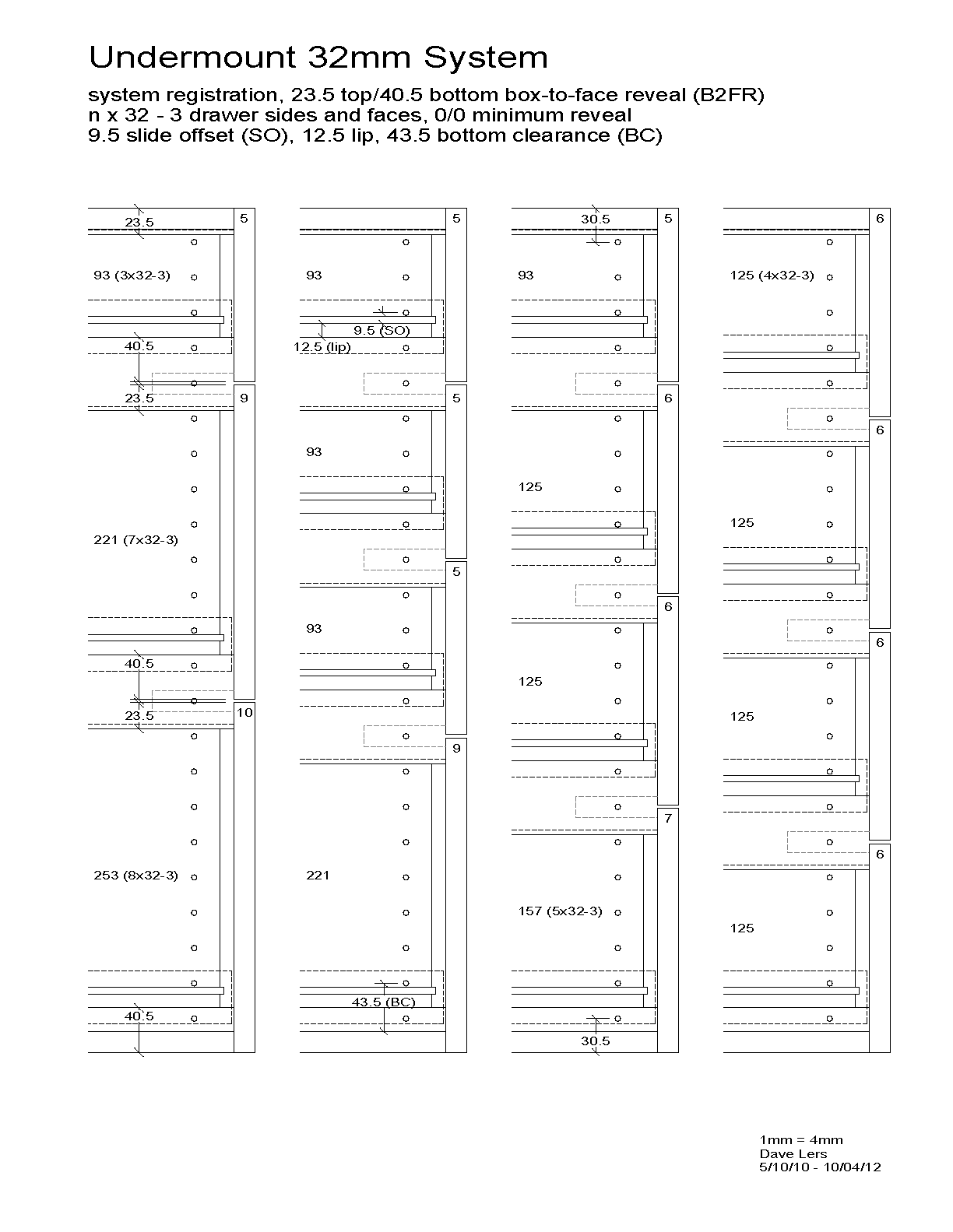 Like the faces, all drawer boxes are some increment of 32mm tall. Doing this provides a consistent relationship between the drawer boxes and faces. While the boxes cannot center on the faces, they will all be the same distance from the top and bottom of all faces. All drawer/face combos can be located anywhere in the stack.
While wood drawer box height can be plus or minus a constant (e.g. to provide top clearance), the bottom clearance is fixed. With under and bottom mount slides, the bottom drawer slide mounting hole determines how far the bottom of all drawer boxes will be from the bottom of all faces.
All system registered cabinets (0 bottom reveal) have a system hole 62.5 from the bottom of the cabinet. Subtract the cabinet bottom thickness to get available bottom clearance (BC). In the example, 62.5 - 19 = 43.5. Both Blum (example, 37 BC) and Salice (42.5 BC) under-mounts will work. Bottom-mounts (~19), Metabox (~19) and Zargon (~16) waste too much space.
[ link | top ]
Shifted Registration
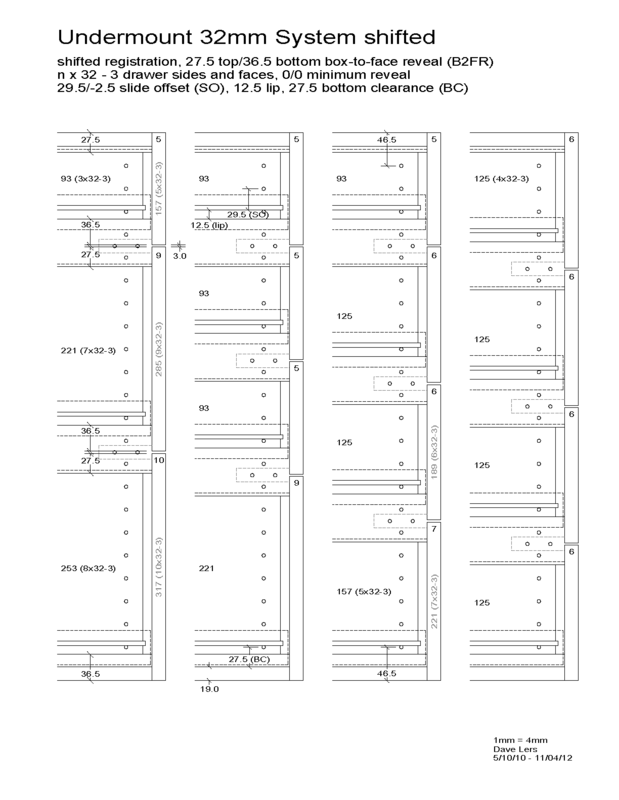
 I first heard of "Shifted" system rows from Keith Hill and Bob Buckley (True32) in the late '90s. Blum has since ('04?) switched from "System" to "Shifted" for their Process 32. The system rows on any given panel design can be shifted vertically by 16mm. When the system rows are shifted, all door and drawer top and bottom edges (plus 1/2 reveal) center between system holes. Shifting the system rows can provide additional bottom drawer clearance without breaking the 32mm system.
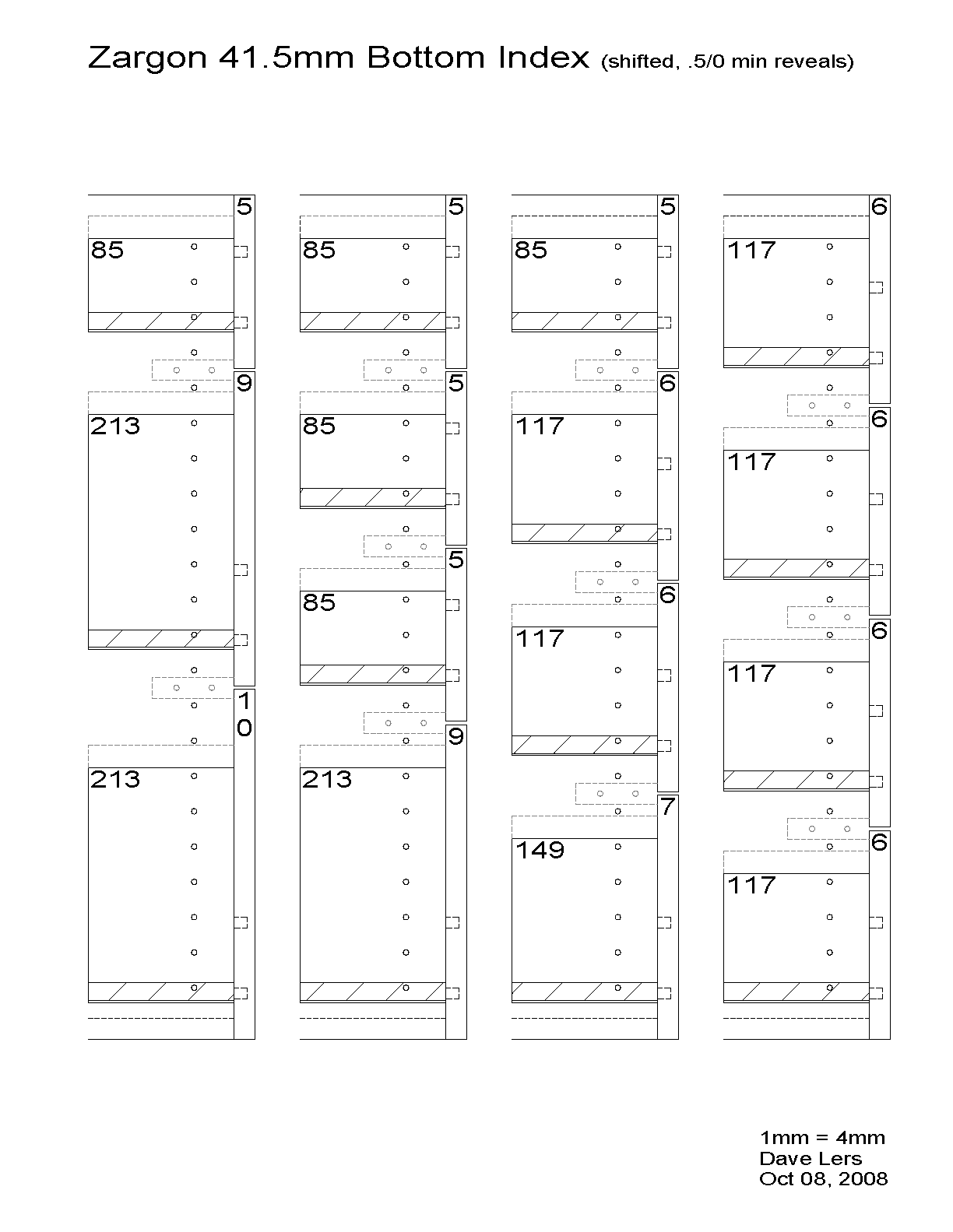
All cabinets using shifted system holes, and having no bottom reveal, have a system hole 46.5 from the bottom of the cabinet (assuming 3mm gaps, 48 - 1/2 gap = 46.5). With 19mm stock, BC is 27.5 (46.5 - 19). While not great, Bottom-mounts, Metabox and Zargon (example) work much better here (VS sys reg). Under-mounts with a second row of mounting holes, e.g. 37/25 BC, also work a bit better here. While the bottom slide can only be mounted using the lower row, and while it seems silly to not mount the rest of the drawers using the top row, it's the only way to maintain consist relationship between all drawer boxes and faces. Salice undermounts (42.5/30.5BC) won't work here, neither will Tandembox (single row 33BC)... Going up a hole (59.5 BC), Grass Nova Pro (49.5 BC) works OK, Hafele Classic (56 BC) works much better.
[ link | top ]
Increased Reveal
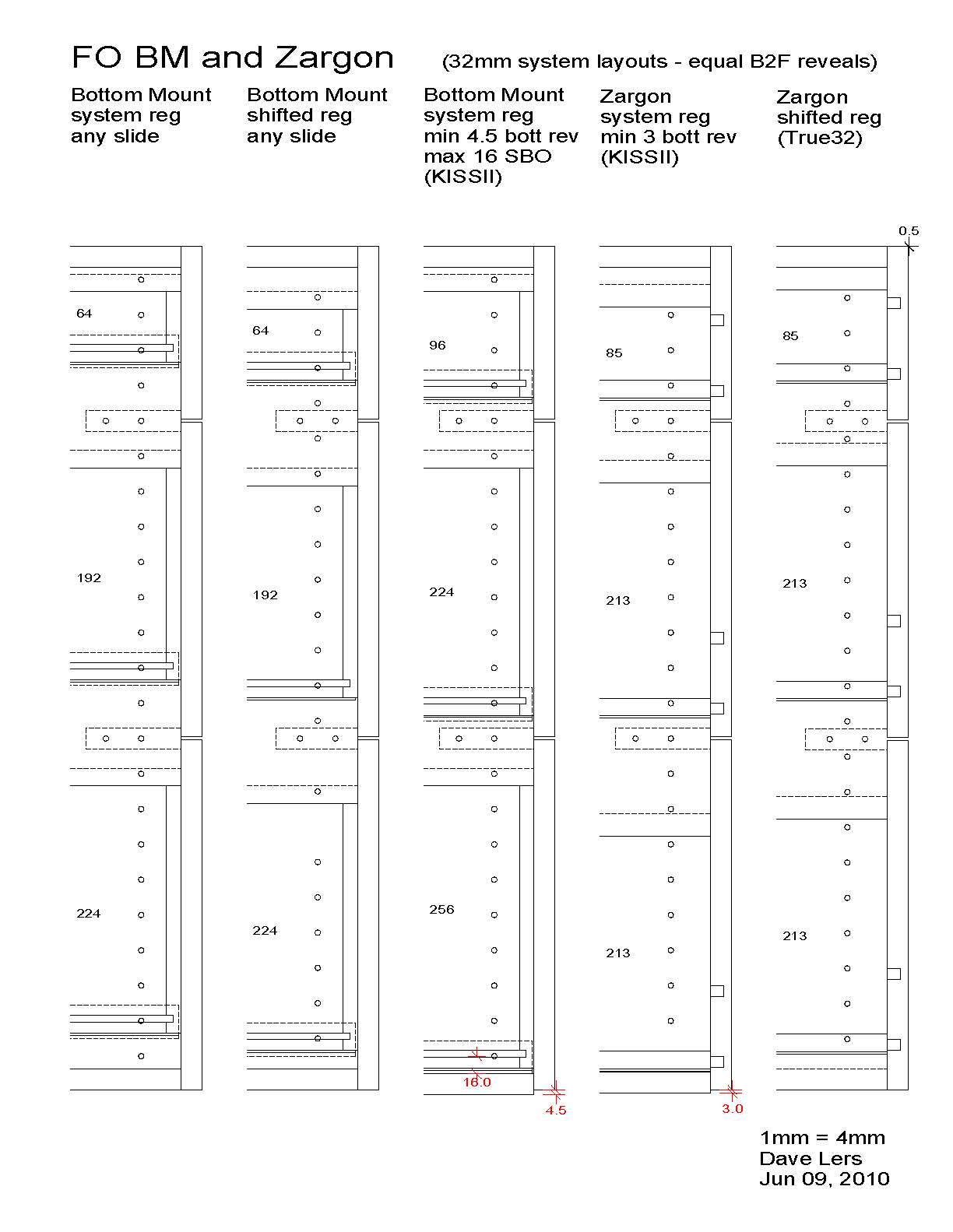 The KISS II system, with its 4.5mm bottom (and top) reveal, allows for better drawer layouts when using Grass Zargon or Grass/Hettich bottom-mount slides. I know of no other brands or styles of slides that benefit from the KISS II 4.5mm bottom reveal. Increased reveals can be used with Shifted and System panel designs. The drawback is that bottom reveals can look bad, especially on uppers where the box banding is not an exact match to the door faces.
With no bottom reveal, the distance from the drawer slide mounting hole to the top of the cabinet bottom (BC) is typically 43.5 system/27.5 shifted (3mm gaps, 19mm deck). Increasing bottom reveal by 4.5 lowers the cabinet bottom by 4.5 which increases BC by 4.5. KISS (system reg) has a BC of 48 (43.5 + 4.5) or 16 (48 - 32).
...The Grass Nova Pro requires a 49.5 BC and the KISS II manual suggests they are usable and to use the side adjustment screws (+/-2mm) to drop the bottom face 1.5mm (49.5 - 48 BC = 1.5). With shifted 0 bottom reveal cabinets the Nova slides would be 10mm off the deck.
When using undermounts, bottom reveals greater than 0 and less than 9.5mm only add space under the bottom system registered drawer. With shifted registration, the bottom reveal would need to be increased to 9.5 to move standard undermounts (37 BC, 27.5 + 9.5 reveal) down one system hole (e.g. HO's 11mm reveal).
[ link | top ]
Plus 32
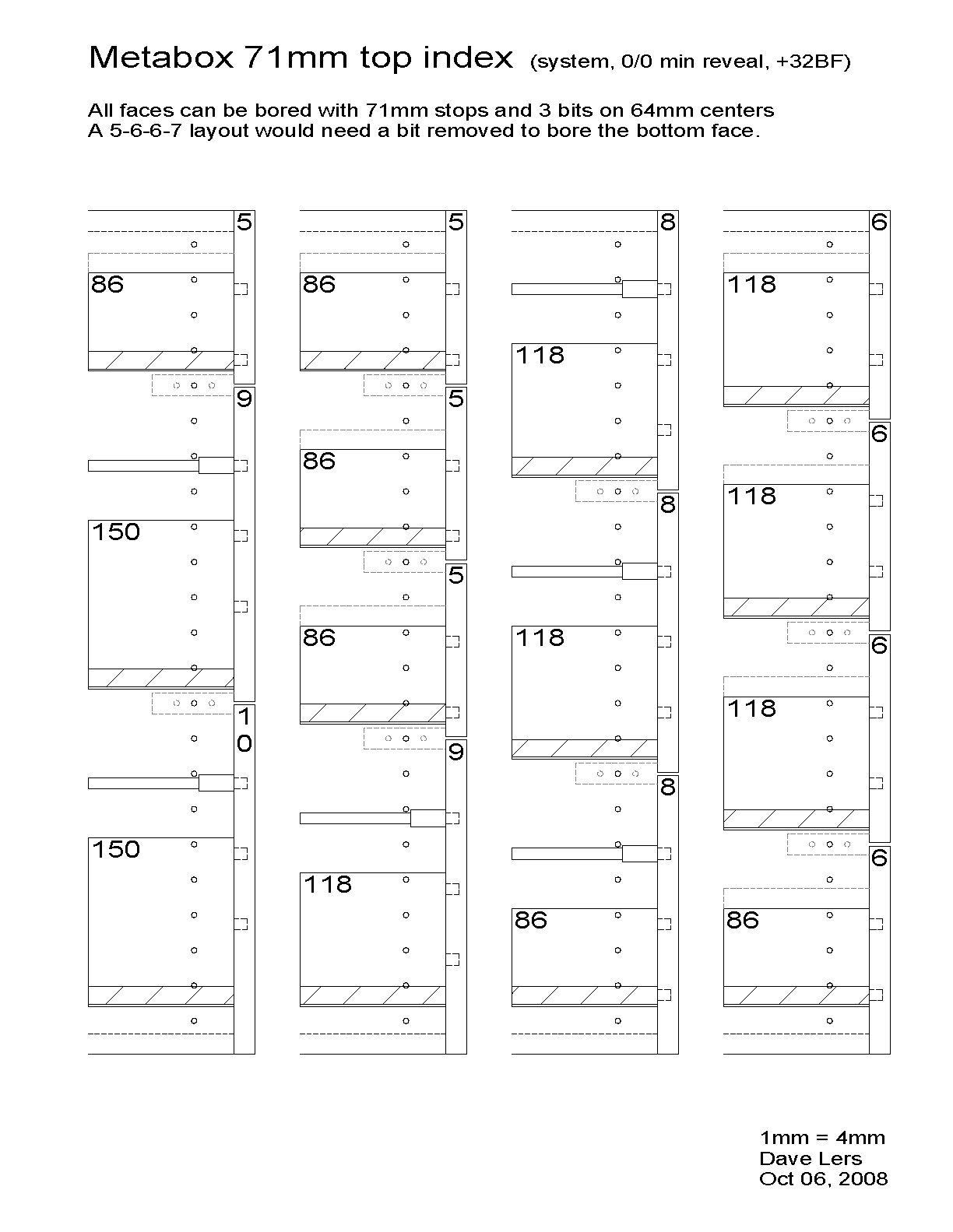 Making the bottom drawer box 32mm smaller and moving the bottom slide up a notch is another possibility. Doing this increases the bottommost drawer box to face reveal by 32mm. The gained usable space in the rest of the drawers can more than make up for the 32mm loss in the bottom drawer. A plus-32 bottom face can be center or top indexed (which excludes the bottom indexed Zargon slides). With full overlay bottom faces, top indexing is the best option. A plus-32 face can be used with Shifted and System panel designs. The example is one of the best layouts I've been able to come up with for Metabox slides (71mm top index).
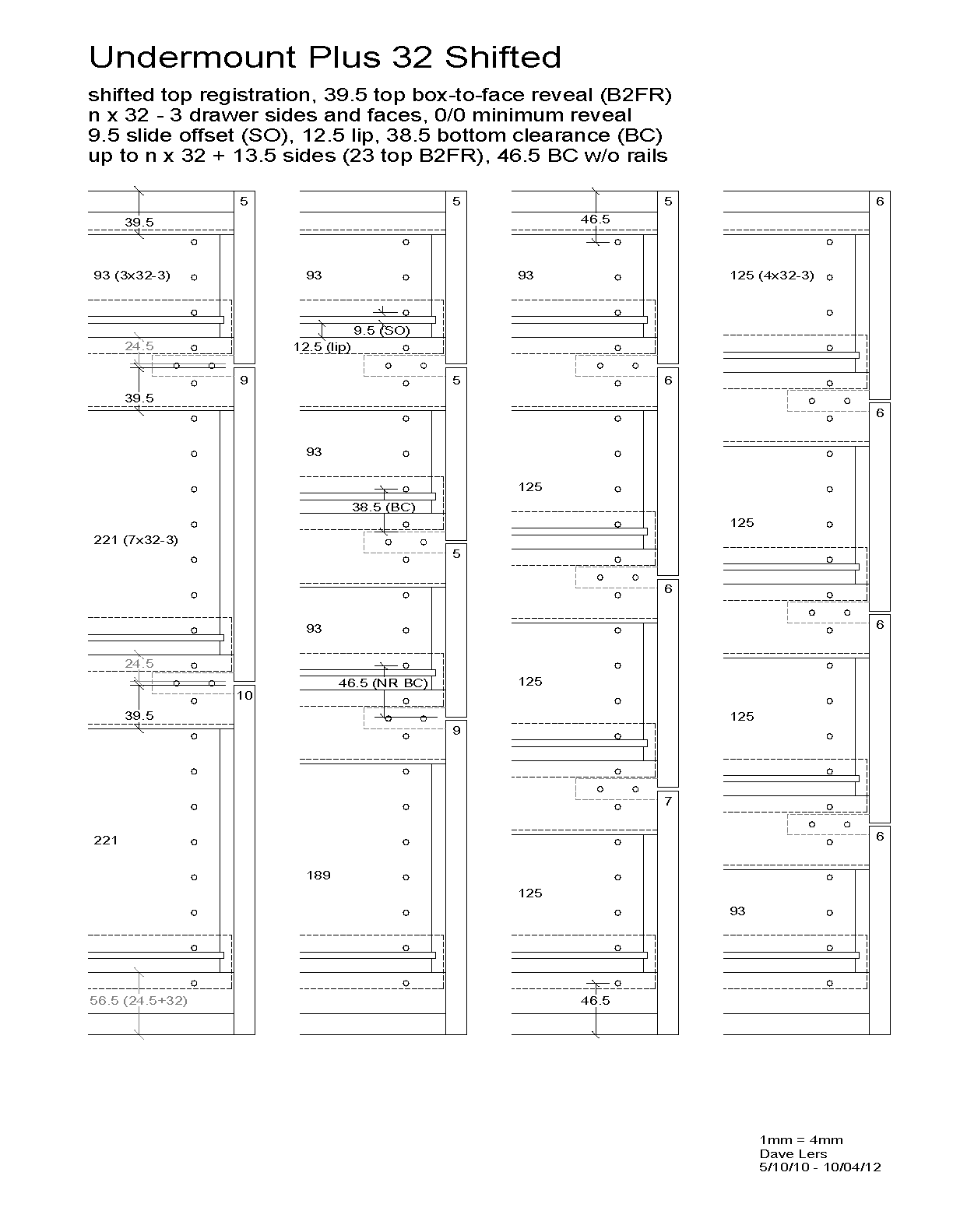 Plus 32 is great if the drawer face above the bottom face is one increment smaller because the bottom two drawer boxes (or Metabox side/slide) are the same size. Another plus, when using shifted registration, is that the drawer boxes can be (32 x n) + 5 (- 3 in the example, up to + 13.5 works) which makes the top of all drawer boxes 32mm below the tops of the drawer faces. Holes for mounting the faces (via screws, adjusters, dowels, whatever) can be some multiple or increment (+/- a constant) of 32mm from the top of all faces and boxes.
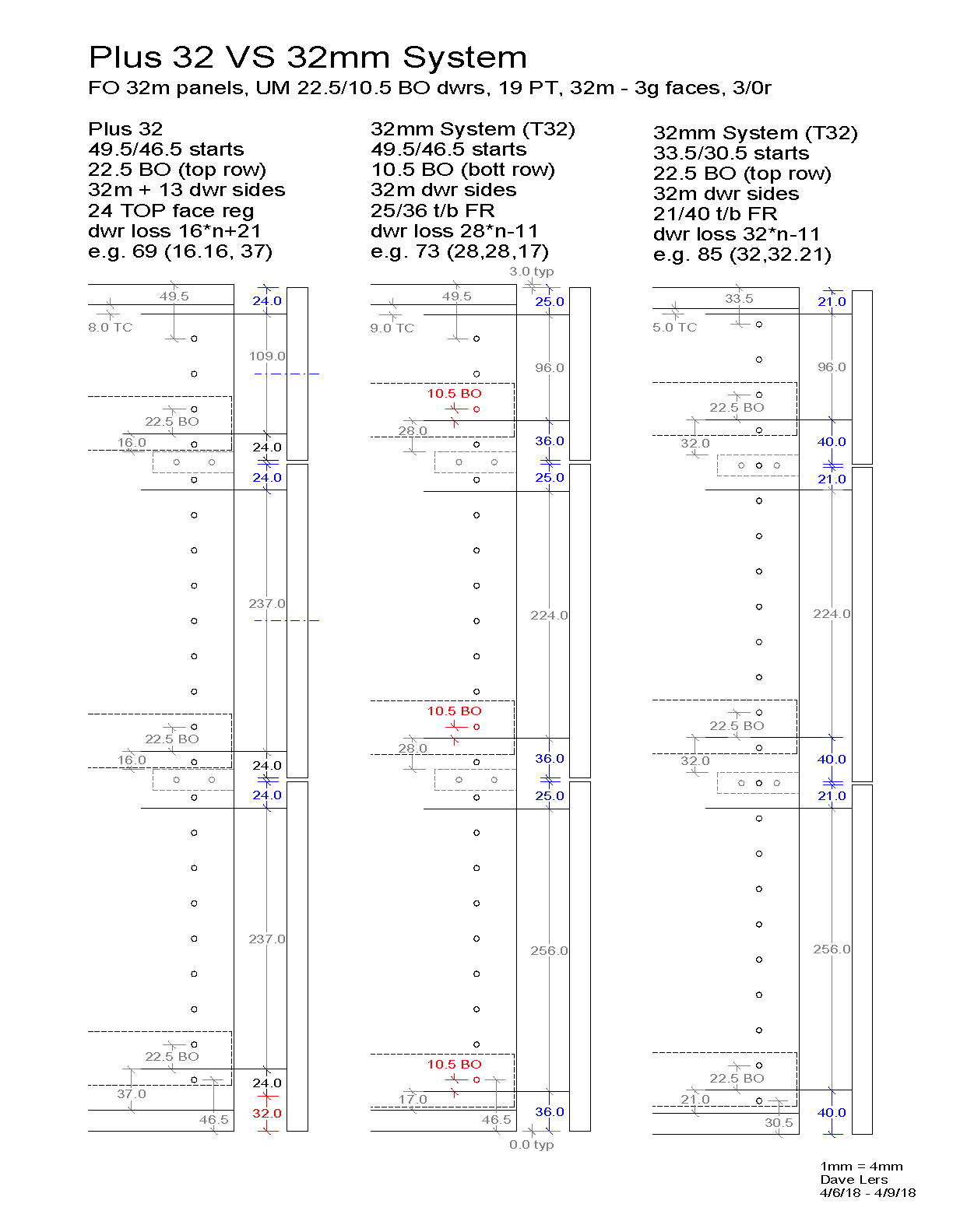 ...This drawing compares Plus 32 with straight 32mm system undermount drawer layouts. While the Plus 32 layout doesn't gain a significant amount of space (+4/16mm) on a three drawer layout, it moves all lost space to the bottom of the cabinet. For every additional drawer, Plus 32 gains 13/16mm (shifted/system reg) more usable space. The shifted registration example (middle) uses the lower row of mounting holes (not all slides have them).
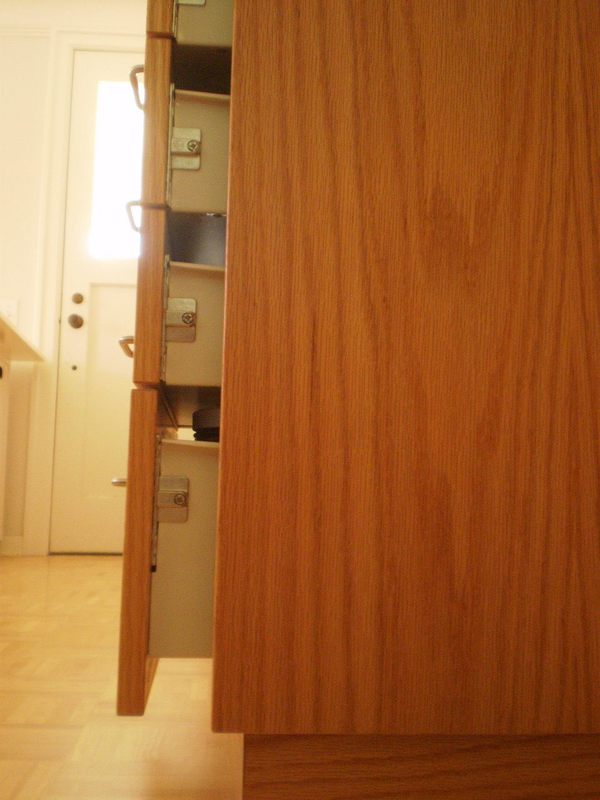
Example image is a plus-32 drawer bank with shifted top registration (no rails).
[ link | top ]
Minus 12
Blum's Process 32 mounts the bottom drawer slide 12mm higher when using Tandem and Solo drawer slides. With undermounts this means using the bottom row mounting holes for the bottom drawer. For the Tandembox slides/sides it means drilling an off system hole 12mm up from a system hole and boring the mounting holes 12mm higher on the drawer face (same goes for the undermounts if you use drawer front adjusters). This breaks the system because there is no longer a consistent relationship between all drawer boxes and faces.
...The only way to create a consistent relationship when using Tandem or Solo wood boxes (with Minus 12) would be to use 32m (+c) drawer boxes and make all bottom drawer boxes 12mm shorter (why what was called Plus 12 is now called Minus 12). The result would be that the top of all drawer boxes would be an equal distance from the top of the drawer faces (TFR). The Minus 12 workaround (3rd 3example in Drawers : Full Overlay Undermount) wouldn't work with 32mm increment metal sides (e.g. tandembox).
One modular alternative is Plus 32 (e.g. Metabox 71 TFR, Tandembox 64).
[ link | top ]
...The only way to create a consistent relationship when using Tandem or Solo wood boxes (with Minus 12) would be to use 32m (+c) drawer boxes and make all bottom drawer boxes 12mm shorter (why what was called Plus 12 is now called Minus 12). The result would be that the top of all drawer boxes would be an equal distance from the top of the drawer faces (TFR). The Minus 12 workaround (3rd 3example in Drawers : Full Overlay Undermount) wouldn't work with 32mm increment metal sides (e.g. tandembox).
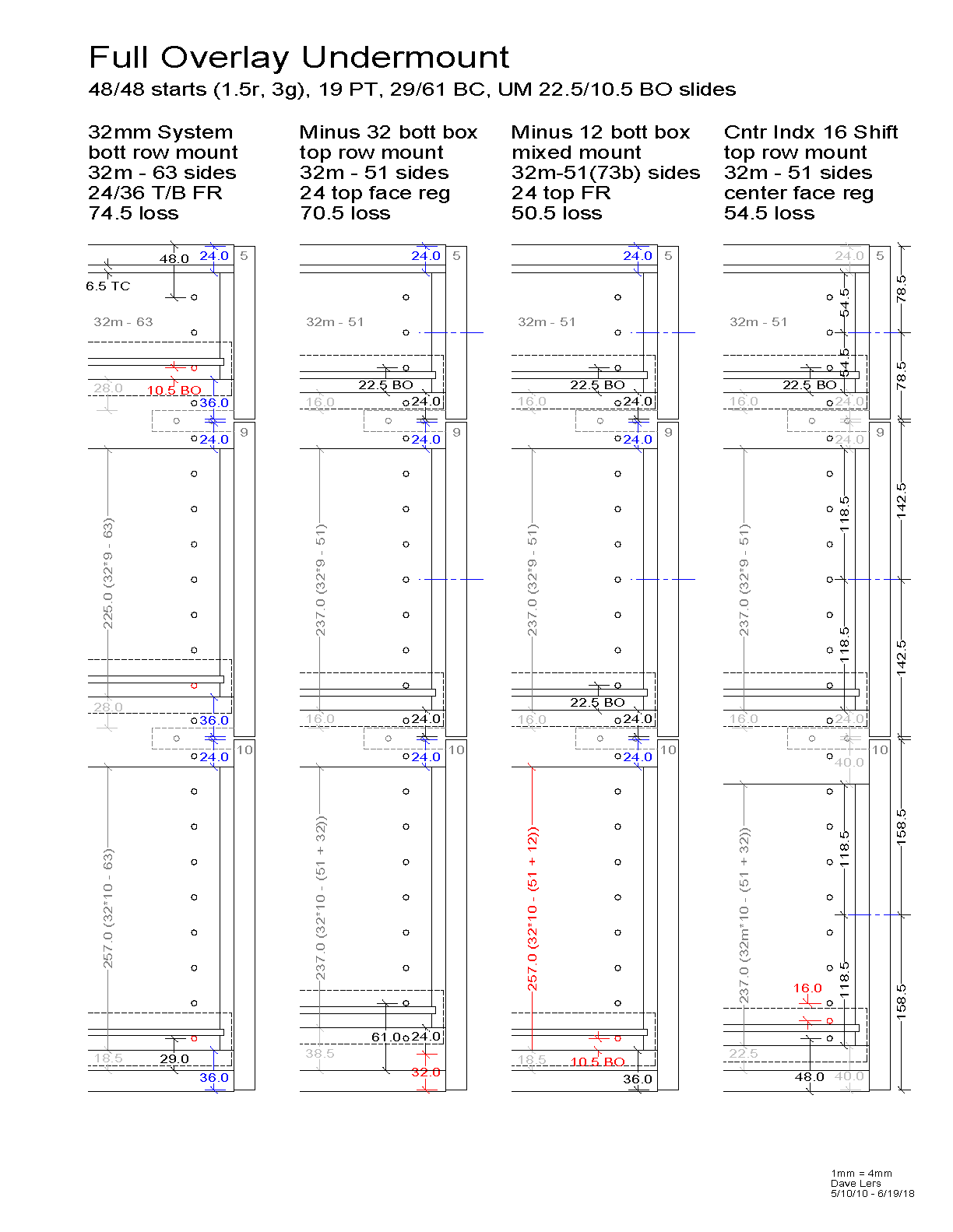
One modular alternative is Plus 32 (e.g. Metabox 71 TFR, Tandembox 64).
[ link | top ]
Plus 14 "B" Rule
An early method of increasing bottom drawer clearance was The Pearls (Blum). The Pearls used a panel (12.5/12.5mm start holes) that would have had 14/14mm reveals without their "B rule". The "B rule" was that 14mm be added to all bottom drawer and door faces. While the "B rule" provides good drawer clearance, it breaks the 32mm system*. The most obvious side effect is that door hinge cup boring becomes unbalanced.
[ link | top ]
[ link | top ]
Center Indexing
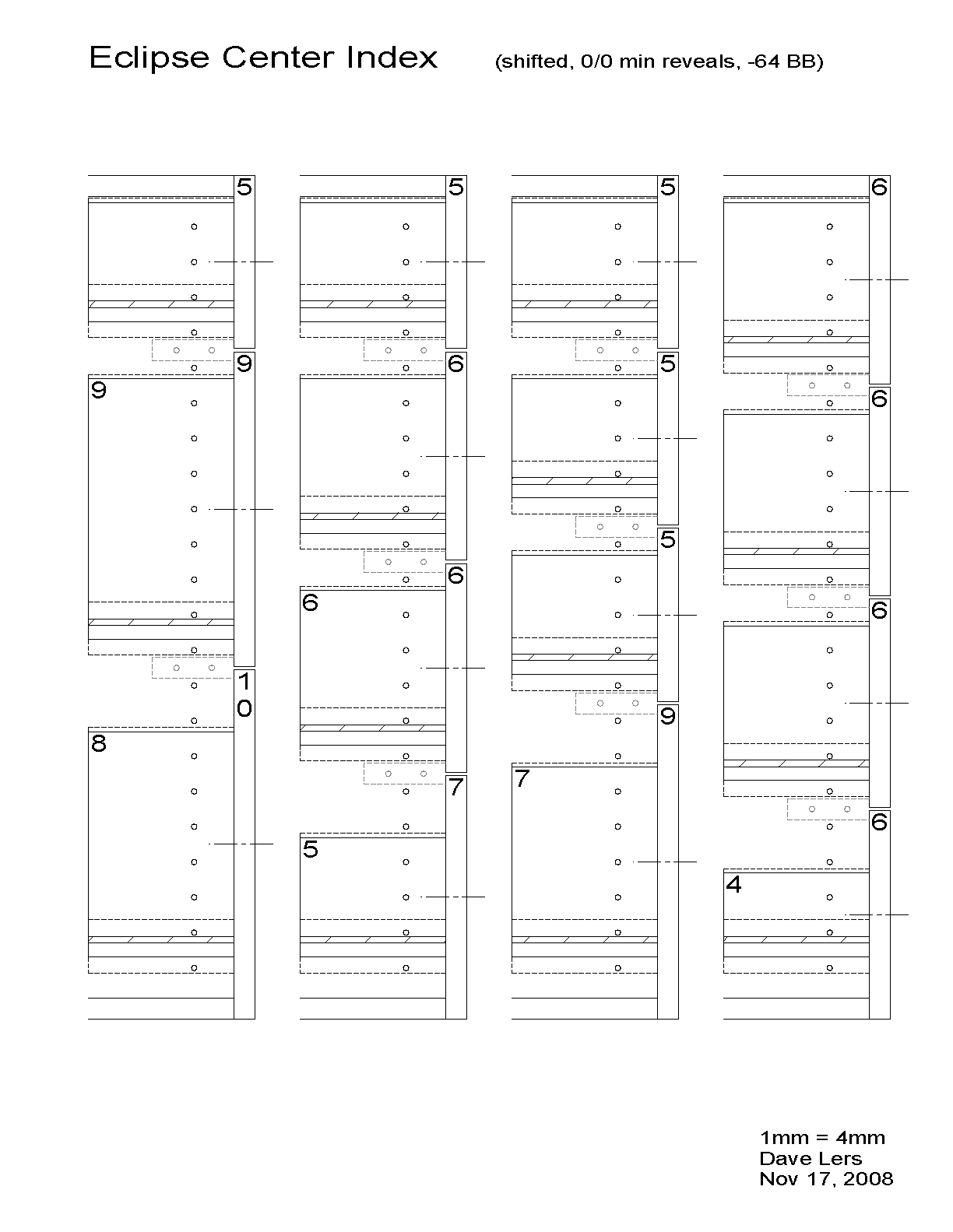 Center indexing is when the center of the drawer box and face center on, or between, the same system holes. True center indexing (same top/bottom face reveal) is only possible with half-overlay and flush-inset cabinets. With full-overlay cabinets, bottom (and top) clearances become an issue. With center indexed drawers, the top and bottom box-to-face reveals need to be the same. Using a plus 32 face, the bottom box needs to be 64mm smaller to increase both the top and bottom face-to-box reveals by 32mm, i.e. is a pretty lousy option.
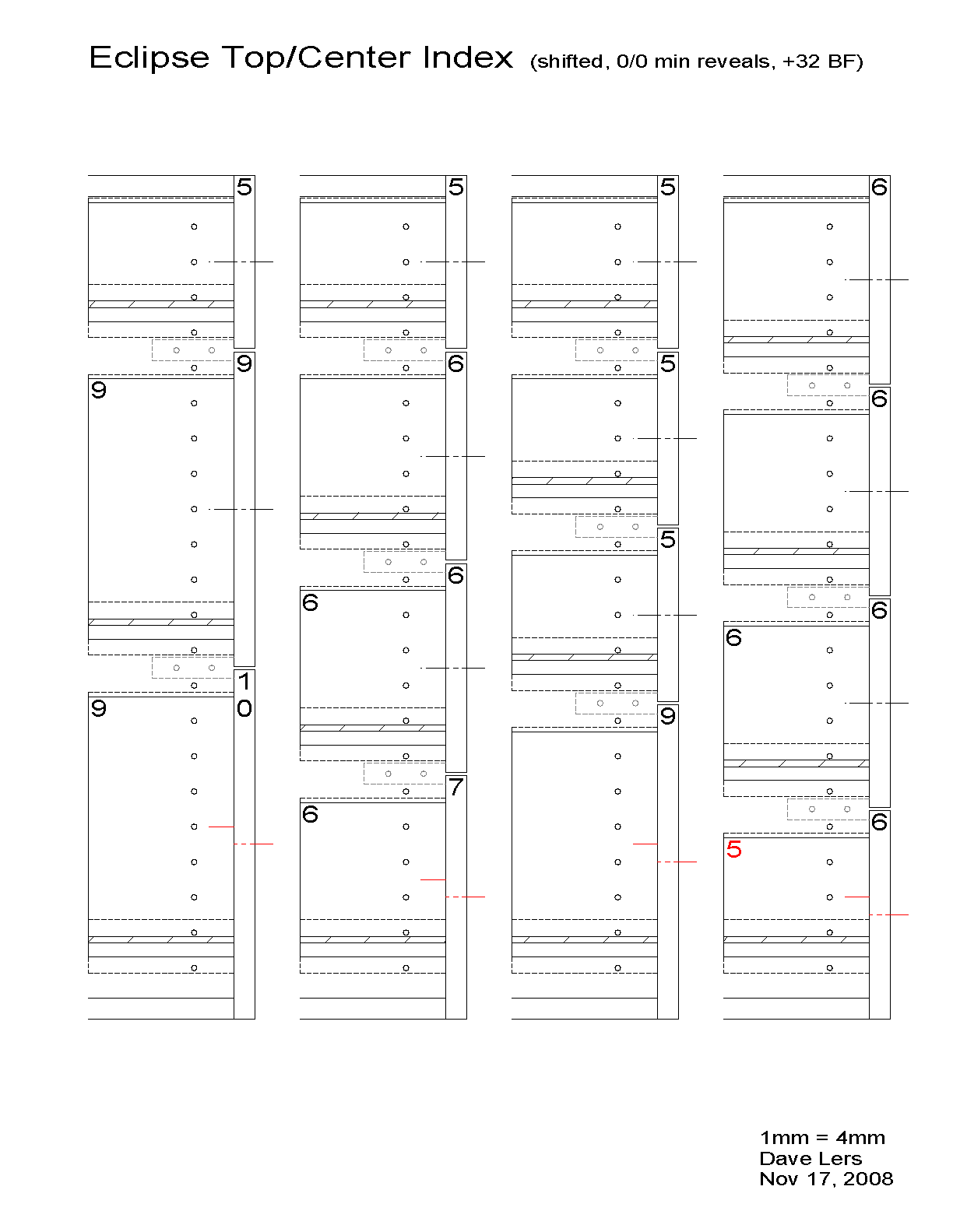 When using boxes sized for center indexing, adding 32mm to the bottom of a face has no affect on the top box-to-face reveals. All hardware can be mounted some increment of 32mm plus (box) or minus (face) top reveal. With drawer layouts where the face above the plus-32-face is 32mm smaller, the two boxes will be the same size, i.e. top indexing can reduce the the number of box sizes. Holes for drawer front adjusters can be the same for both drawers. The only drawback is that you cannot bore for centered pulls at the same time. That may not matter, e.g. if all pulls get bored an equal distance from the top of the faces. While I've improved the layout (its the same as Plus 32 above), the bottom drawers are not center indexed, i.e. is not a valid center indexing option.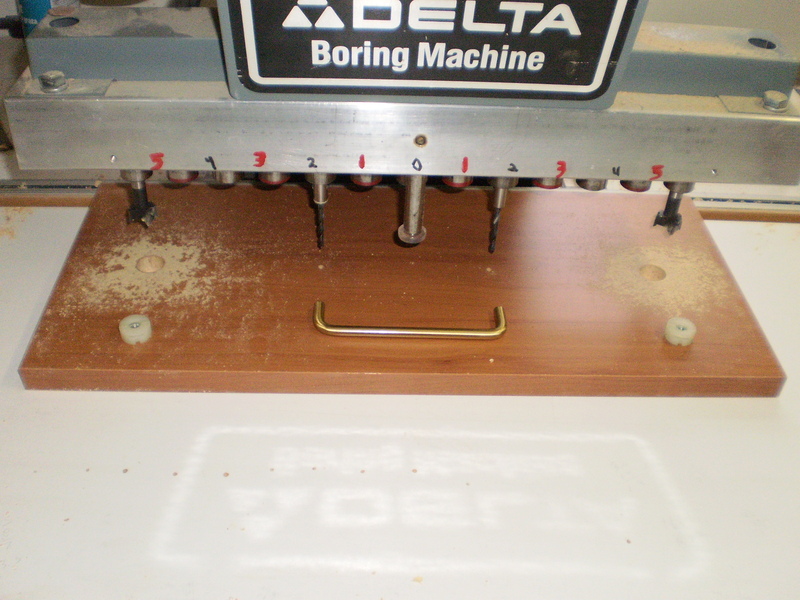
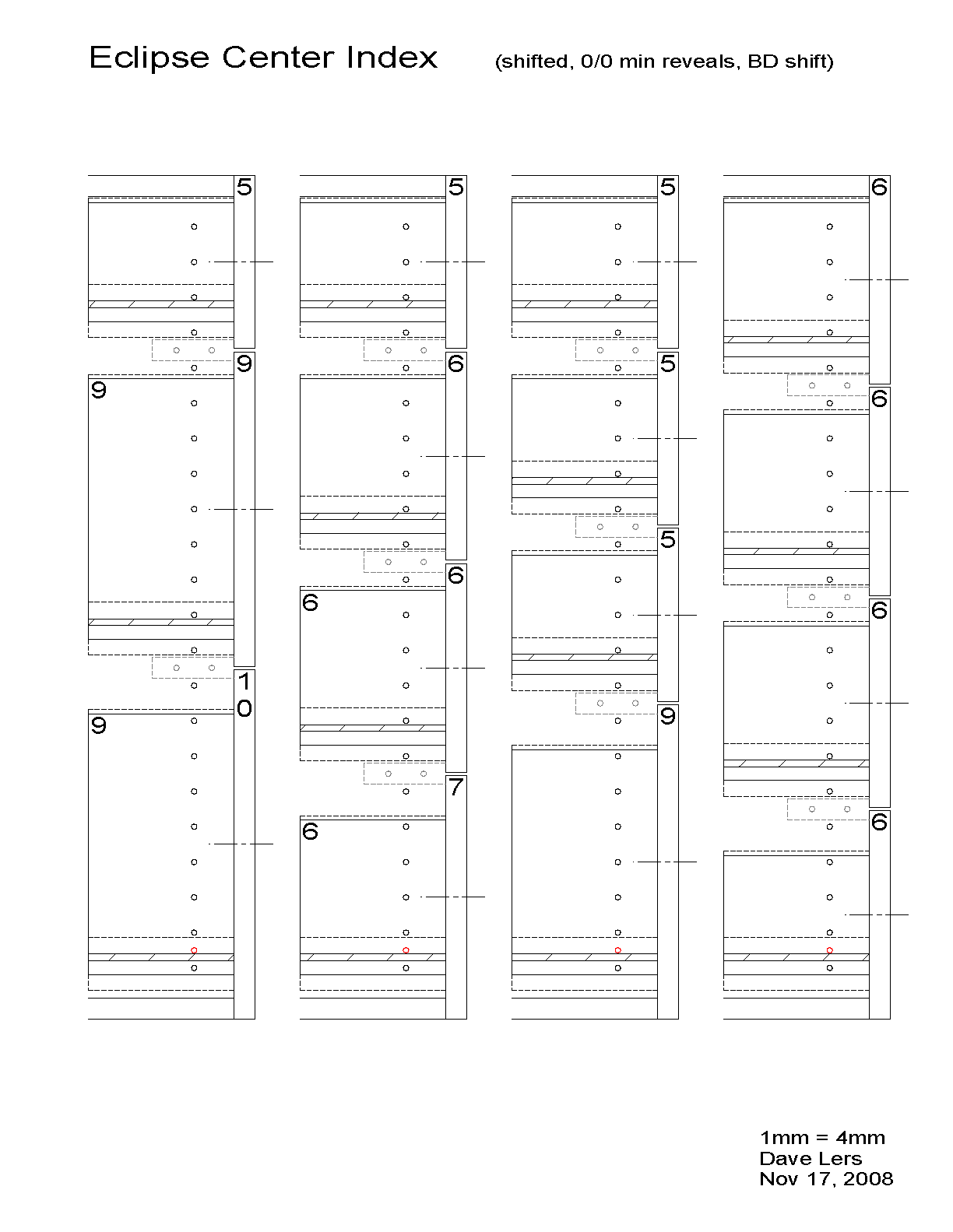 The only reasonable method I've been able to come up with (for full-overlay) requires drilling extra holes for mounting the bottom slide. When the slides of the above top-indexed bottom box are moved down 16mm (mounting holes centered between system holes), the box is once again centered on the face. While centered, the box-to-face reveals for the shifted drawer are 16mm bigger than the rest. This isn't an issue because increments of 32mm can be odd or even and the center of odd increment faces are always some increment of 16mm (never 32mm) bigger/smaller than even increment faces. In other words, doing this breaks nothing. All faces will center on all boxes. The only difference is that the bottom box gets a 32mm bigger face. This option (and Plus 32) only bugs me when the bottom two drawer faces are the same size and the bottom box is 32mm smaller (far right in the example drawing).
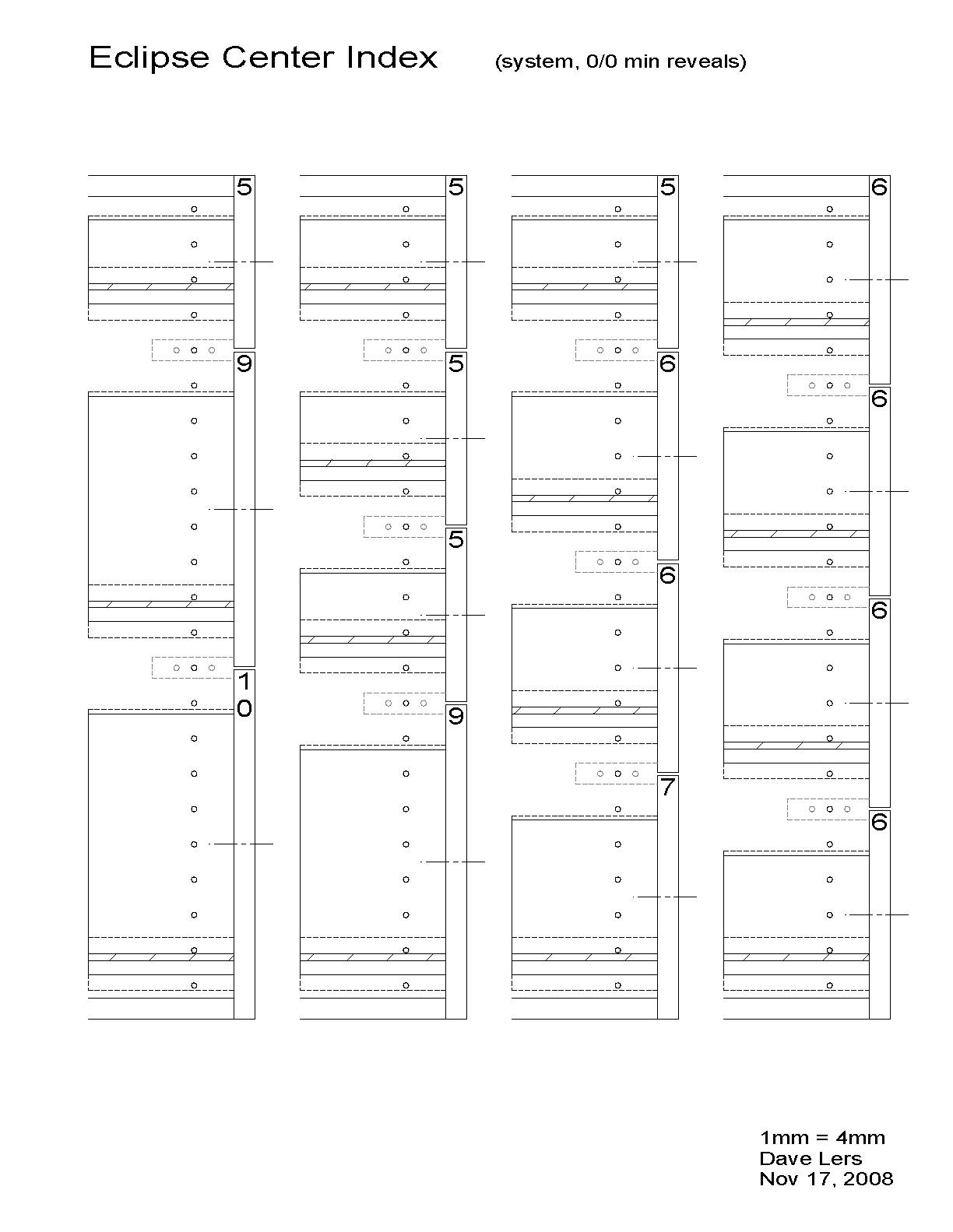 ...Above I had said that true center indexing is only possible with half-overlay and inset cabinets. Apparently I had rejected this system registration drawing (the three examples above use shifted registration) because it wasted too much space. None the less, it is an example of true center indexing.
 Note: While the drawings are labled Eclipse, the Eclipse box offset specs are the same/very close to most undermount specs (22.5 BO). If you want any of these drawings updated, e.g. with dimensions/specs, let me know.
See also: Full Overlay Undermount. The 3rd example in both drawings is center indexed.
[ link | top ]